Mourning and Sensuality

Part 1: Mourning

Public shows of grief came to predominate in 19th century Britain, as epitomized by the 40-year long period during which Queen Victoria mourned the death of her beloved husband Albert, beginning in 1861 and ending with her death in 1901. Her example helped elevate the practice, as did the work of the era’s most prominent poet, Alfred Tennyson. After his best friend, Arthur Hallam, died in 1833, aged 22, Tennyson spent the next 17 years producing a book-length poem wrestling with that loss, titled In Memoriam, A.H.H. obit. MDCCCXXXIII.

Reading: Three pieces by Tennyson mourning the loss of Arthur Hallam.

Part 2: Sensuality

While the Victorians have a well-deserved reputation for sexual prudery, their poetry and art are often suffused with sensuality.

Reading: Two Poems

Viewing: four Pre-Raphaelite paintings:

  • William Holman Hunt, The Lady of Shalott (1888-1905)
  • John William Waterhouse, The Lady of Shalott (1888)
  • John Everett Millais, Ophelia (1851)
  • Dante Gabriel Rossetti, Lady Lilith (1866-68)

Note: if you’re unfamiliar with the legend of Lilith or with the role of Ophelia in Hamlet, take a moment to google those names.

Writing: Respond to ONE of the following prompts. Keep your response short, posting as a reply under the appropriate heading in the comments section:

  1. Call our attention to a particularly moving line or detail from one of Tennyson’s poems of mourning.
  2. At the end of Part II, the Lady of Shalott declares “I am half sick of shadows.” Unfold the significance of this key line.
  3. It’s hard not to come away from Rossetti’s “Goblin Market” identifying the goblins’ fruit with sexuality. What details in the poem help to create this association? On the other hand, what details in the poem complicate or undermine the association?

“Modern Greece”

Felicia Hemans was the daughter of a well-connected importer of Italian wines based in Liverpool and Wales. A gifted linguist and poet, she was acquainted with Wordsworth and Shelley. Though highly popular and widely read, her reputation declined in the decades after her death—a common plight of women writers in the 18th and 19th century. That trend has been reversed over the past thirty years, however, and her work now appears in many anthologies.

In 1817 Hemans anonymously published Modern Greece. Written in the metrical style of Byron’s Childe Harold from two years earlier, the poem was initially attributed to Byron, despite Hemans’ decidedly different attitude toward Lord Elgin’s seizure of the Parthenon Marbles, as shown in the following passage.

From Modern Greece
86      Oh! live there those who view with scornful eyes
     All that attests the brightness of thy prime?
     Yes; they who dwell beneath thy lovely skies,
     And breathe th’ inspiring ether of thy clime!
     Their path is o’er the mightiest of the dead,
     Their homes are midst the works of noblest arts;
     Yet all around their gaze, beneath their tread,
     Not one proud thrill of loftier thought imparts.
     Such are the conquerors of Minerva’s land,
Where Genius first reveal’d the triumphs of his hand!
thy prime: the poem is addressed to the land of Greece, great in its “prime,” but lying now in ruins

conquerors of Minerva’s land: the Turks, who conquered Athens in 1456.

87      For them in vain the glowing light may smile
     O’er the pale marble, colouring’s warmth to shed,
     And in chaste beauty many a sculptured pile
     Still o’er the dust of heroes lift its head.
     No patriot feeling binds them to the soil,
     Whose tombs and shrines their fathers have not rear’d,
     Their glance is cold indifference, and their toil
     But to destroy what ages have revered,
     As if exulting sternly to erase
Whate’er might prove that land had nurs’d a nobler race.
For them: the Turks
88      And who may grieve that, rescued from their hands,
     Spoilers of excellence and foes to art,
     Thy relics, Athens! borne to other lands,
     Claim homage still to thee from every heart?
     Though now no more th’ exploring stranger’s sight,
     Fix’d in deep reverence on Minerva’s fane,
     Shall hail, beneath their native heaven of light,
     All that remain’d of forms adored in vain;
     A few short years—and, vanish’d from the scene,
To blend with classic dust their proudest lot had been.
89      Fair Parthenon! yet still must fancy weep
     For thee, thou work of nobler spirits flown.
     Bright, as of old, the sunbeams o’er thee sleep
     In all their beauty still—and thine is gone!
     Empires have sunk since thou wert first revered,
     And varying rites have sanctified thy shrine.
     The dust is round thee of the race that rear’d
     Thy walls; and thou—their fate must soon be thine!
     But when shall earth again exult to see
Visions divine like theirs renew’d in aught like thee?

Citation: Hemans, Felicia. Modern Greece, 1817. Text from Project Gutenberg, 2021. Edited by Charles Henebry, 2023. hum104.commacafe.org/modern-greece

“Childe Harold’s Pilgrimage”

A close friend of Shelley, the Romantic poet Lord Byron himself embodied many of the qualities of the Romantic hero: brilliant, moody, driven. His thirst for fresh experience sent him on travels around Europe, and he spent much of his adult life in Italy and Greece. He died in 1824 fighting in the Greek War of Independence against the Ottoman Turks.

In 1815 Byron published the first two parts of a semi-autobiographical poem titled Childe Harold’s Pilgrimage. Its second canto opens on the steps of the Parthenon in Athens. The ruin occasions a meditation on religion and the sweep of history, ending with a forceful condemnation of Lord Elgin’s looting of the temple’s marble frieze.

From Canto the Second
1      Come, blue-eyed maid of heaven!—but thou, alas,
     Didst never yet one mortal song inspire—
     Goddess of Wisdom! here thy temple was,
     And is, despite of war and wasting fire,
     And years, that bade thy worship to expire:
     But worse than steel, and flame, and ages slow,
     Is the drear sceptre and dominion dire
     Of men who never felt the sacred glow
That thoughts of thee and thine on polished breasts bestow.
2      Ancient of days! august Athena! where,
     Where are thy men of might, thy grand in soul?
     Gone—glimmering through the dream of things that were:
     First in the race that led to Glory’s goal,
     They won, and passed away—is this the whole?
     A schoolboy’s tale, the wonder of an hour!
     The warrior’s weapon and the sophist’s stole
     Are sought in vain, and o’er each mouldering tower,
Dim with the mist of years, grey flits the shade of power.
3      Son of the morning, rise! approach you here!
     Come—but molest not yon defenceless urn!
     Look on this spot—a nation’s sepulchre!
     Abode of gods, whose shrines no longer burn.
     E’en gods must yield—religions take their turn:
     ‘Twas Jove’s—’tis Mahomet’s; and other creeds
     Will rise with other years, till man shall learn
     Vainly his incense soars, his victim bleeds;
Poor child of Doubt and Death, whose hope is built on reeds.
….
6      Look on its broken arch, its ruined wall,
     Its chambers desolate, and portals foul:
     Yes, this was once Ambition’s airy hall,
     The dome of Thought, the Palace of the Soul.
     Behold through each lack-lustre, eyeless hole,
     The gay recess of Wisdom and of Wit,
     And Passion’s host, that never brooked control:
     Can all saint, sage, or sophist ever writ,
People this lonely tower, this tenement refit?
….
10      Here let me sit upon this mossy stone,
     The marble column’s yet unshaken base!
     Here, son of Saturn, was thy favourite throne!
     Mightiest of many such! Hence let me trace
     The latent grandeur of thy dwelling-place.
     It may not be: nor even can Fancy’s eye
     Restore what time hath laboured to deface.
     Yet these proud pillars claim no passing sigh;
Unmoved the Moslem sits, the light Greek carols by.
11      But who, of all the plunderers of yon fane
     On high, where Pallas lingered, loth to flee
     The latest relic of her ancient reign—
     The last, the worst, dull spoiler, who was he?
     Blush, Caledonia! such thy son could be!
     England! I joy no child he was of thine:
     Thy free-born men should spare what once was free;
     Yet they could violate each saddening shrine,
And bear these altars o’er the long reluctant brine.
Caledonia: Scotland
12      But most the modern Pict’s ignoble boast,
     To rive what Goth, and Turk, and Time hath spared:
     Cold as the crags upon his native coast,
     His mind as barren and his heart as hard,
     Is he whose head conceived, whose hand prepared,
     Aught to displace Athena’s poor remains:
     Her sons too weak the sacred shrine to guard,
     Yet felt some portion of their mother’s pains,
And never knew, till then, the weight of Despot’s chains.
Picts: a barbarous tribe in ancient Scotland
13      What! shall it e’er be said by British tongue
     Albion was happy in Athena’s tears?
     Though in thy name the slaves her bosom wrung,
     Tell not the deed to blushing Europe’s ears;
     The ocean queen, the free Britannia, bears
     The last poor plunder from a bleeding land:
     Yes, she, whose generous aid her name endears,
     Tore down those remnants with a harpy’s hand.
Which envious eld forbore, and tyrants left to stand.
14      Where was thine aegis, Pallas, that appalled
     Stern Alaric and Havoc on their way?
     Where Peleus’ son? whom Hell in vain enthralled,
     His shade from Hades upon that dread day
     Bursting to light in terrible array!
     What! could not Pluto spare the chief once more,
     To scare a second robber from his prey?
     Idly he wandered on the Stygian shore,
Nor now preserved the walls he loved to shield before.
Alaric: Visigoth king who unsuccessfully invaded Greece

Peleus: father of Achilles

15      Cold is the heart, fair Greece, that looks on thee,
     Nor feels as lovers o’er the dust they loved;
     Dull is the eye that will not weep to see
     Thy walls defaced, thy mouldering shrines removed
     By British hands, which it had best behoved
     To guard those relics ne’er to be restored.
     Curst be the hour when from their isle they roved,
     And once again thy hapless bosom gored,
And snatched thy shrinking gods to northern climes abhorred!

Citation: Byron, George Gordon Byron, Baron. Childe Harold’s Pilgrimage, 1815. Text from Project Gutenberg, 2013. Edited by Charles Henebry, 2023. hum104.commacafe.org/childe-harolds-pilgrimage

George the Poet

George the Poet, “The Benin Bronzes”

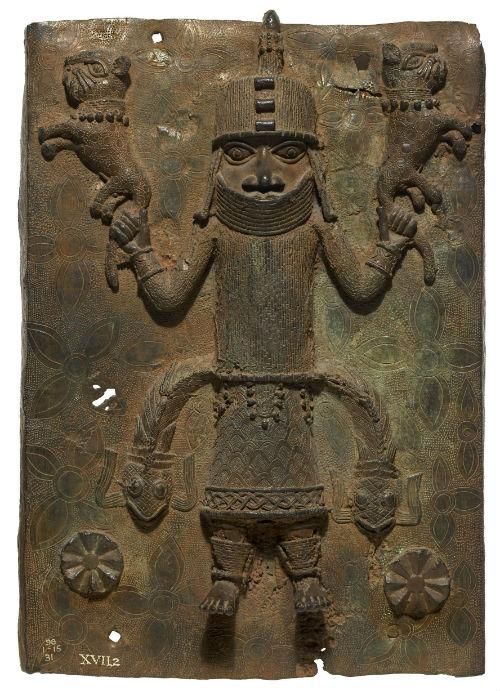
The Benin Bronzes were created for the Royal Court of Benin, an African kingdom that prospered through trade with the Portuguese and other Europeans from the 16th century onward. But in the late 19th century, at a time when the British had come to dominate the West African trade, tensions over the expanded European presence in Africa led to a bloody war and occupation. In the course of pillaging Benin city, these magnificent bronze artworks honoring the kings’ ancestral line were plundered. Many of them are now on display at the British Museum, though some are scattered in other museums around the world. The Nigerian National Commission for Museums and Monuments is in talks with the British Museum about repatriating these artifacts: details on this history and on the current status of negotiations here.

In 2015, as part of the Museum’s “Huge History Lesson” challenge, George the Poet produced the following piece.

On Seeing the Elgin Marbles

In 1817, John Keats saw the Parthenon Marbles, then newly on display at the British Museum. At the time, the Museum was only open to visitors by special arrangement, and Keats visited in the company of the painter Benjamin Robert Haydon, a spirited defender of Parliament’s 1816 decision to buy the Parthenon marbles from Lord Elgin and place them on display at the museum (link). A week later, he published the following two poems in The Examiner:

To Haydon
Haydon! Forgive me, that I cannot speak
Definitively on these mighty things;
Forgive me that I have not Eagle’s wings—
That what I want I know not where to seek:
And think that I would not be over meek
In rolling out upfollow’d thunderings,
Even to the steep of Helciconian springs,
Were I of ample strength for such a freak—
Think too that all those numbers should be thine;
Whose else? In this who touch thy vesture’s hem?
For when men star’d at what was most divine
With browless idiotism—o’erwise phlegm—
Thou hadst beheld the Hesperean shine
Of their star in the East, and gone to worship them.

On Seeing the Elgin Marbles
My spirit is too weak—mortality
Weighs heavily on me like unwilling sleep,
And each imagined pinnacle and steep
Of godlike hardship tells me I must die
Like a sick eagle looking at the sky.
Yet ’tis a gentle luxury to weep
That I have not the cloudy winds to keep
Fresh for the opening of the morning’s eye.
Such dim-conceived glories of the brain
Bring round the heart an undescribable feud;
So do these wonders a most dizzy pain,
That mingles Grecian grandeur with the rude
Wasting of old time—with a billowy main—
A sun—a shadow of a magnitude.

The Course of Empire

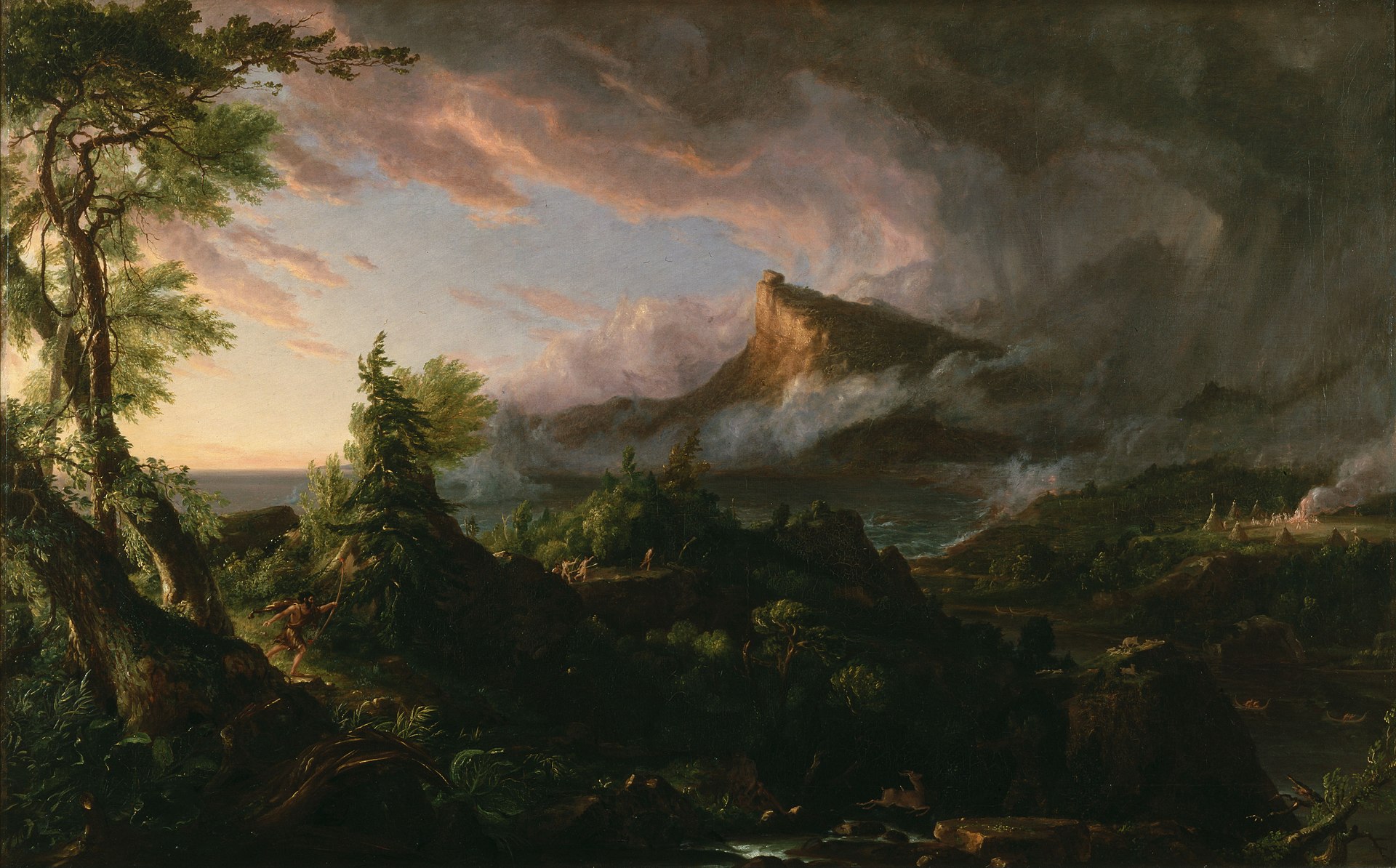
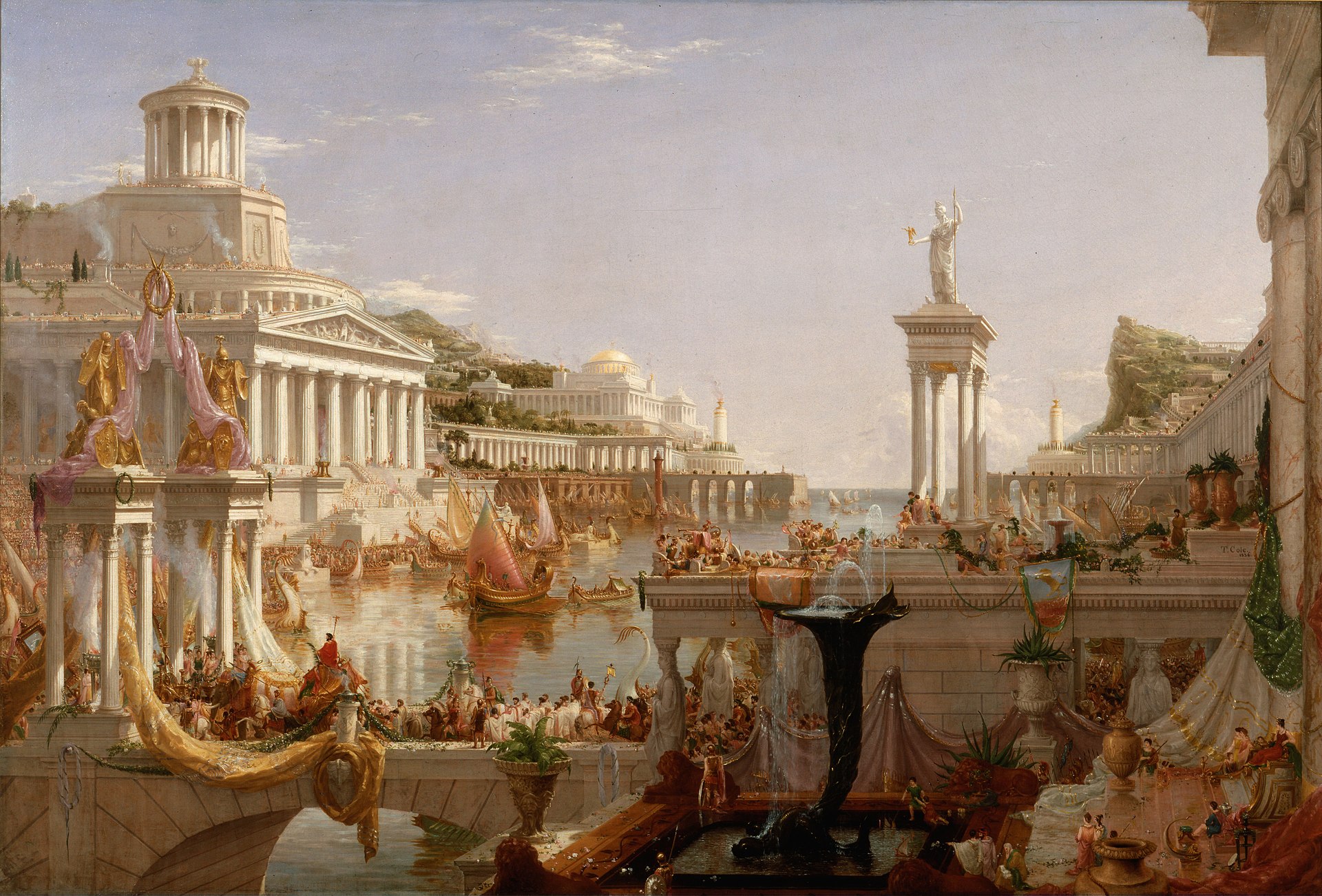
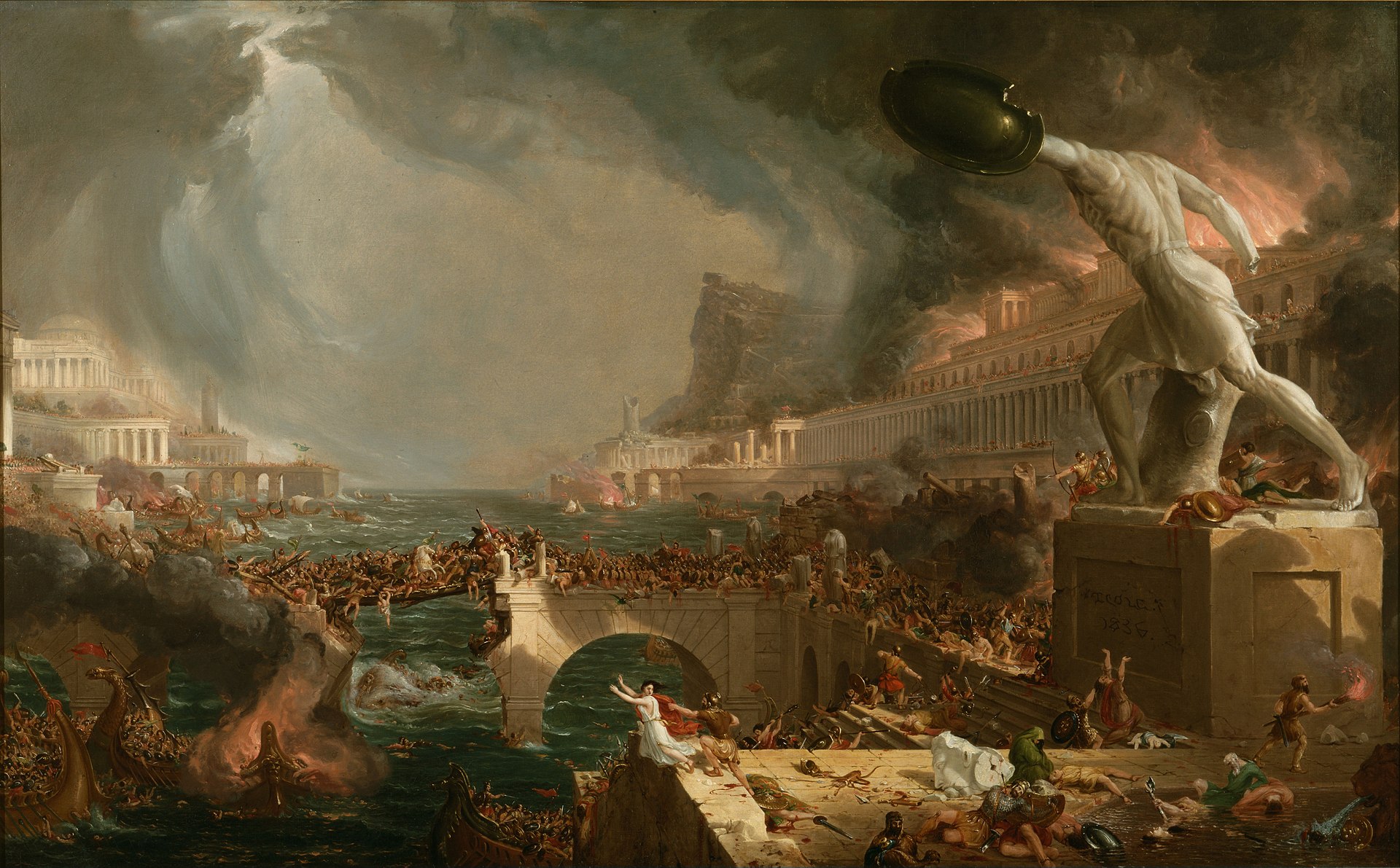
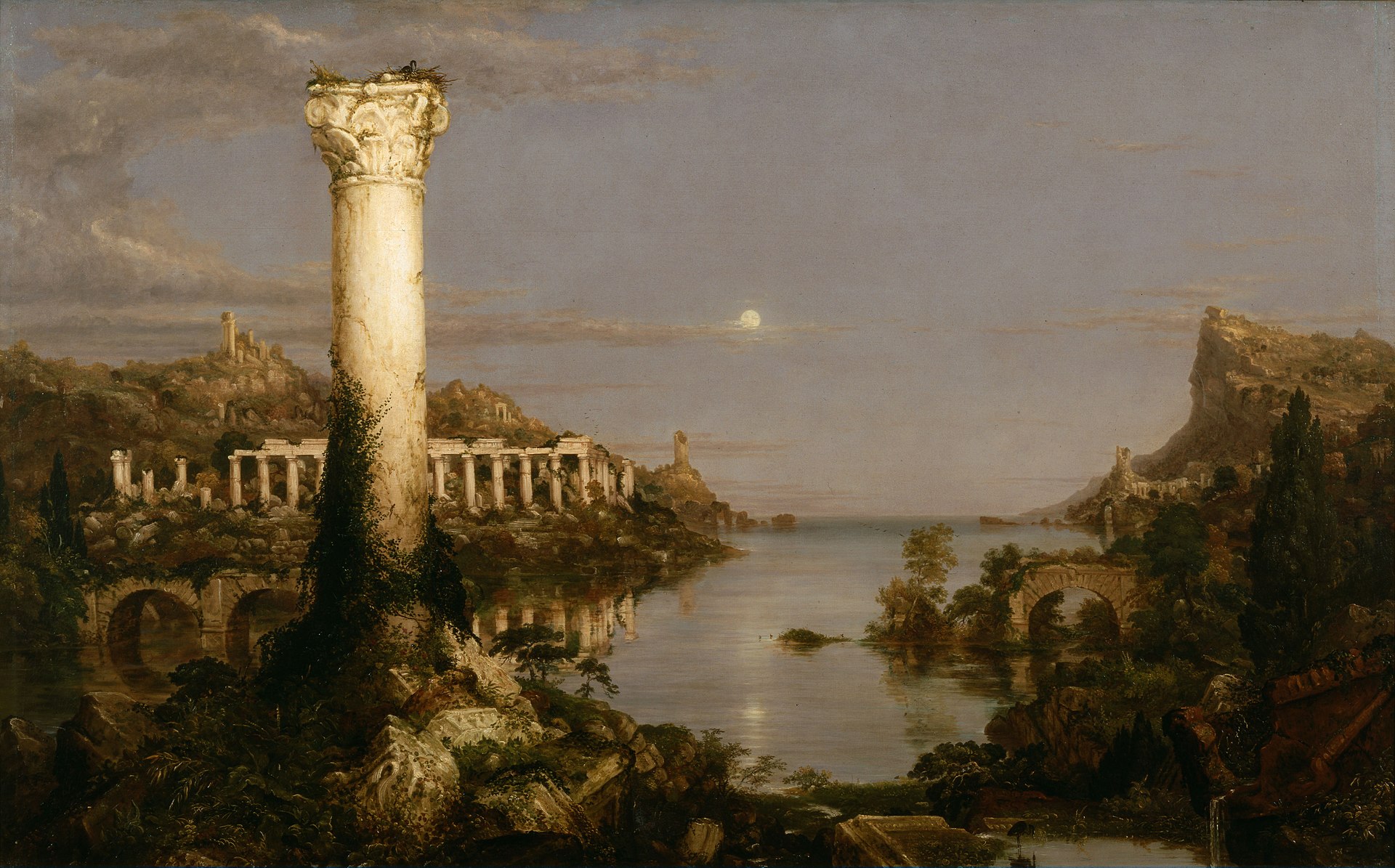
Between 1833 and 1836, Thomas Cole produced a series of five paintings presenting human civilization as having both a rising and a falling phase. Born in England, Cole emigrated to America at 17, and rose to prominence as a leading member of the Hudson River School, painting Romantic history and landscape paintings that sold to prosperous New York businessmen.

Cole’s presentation of civilization in this series undoubtedly reflects American anxieties as to the destiny of that nation, just then emerging from the pastoral stage to material prosperity. Yet similar ideas about the cycle of history can be found in the poetry of English Romantic poets like Shelley and Byron.

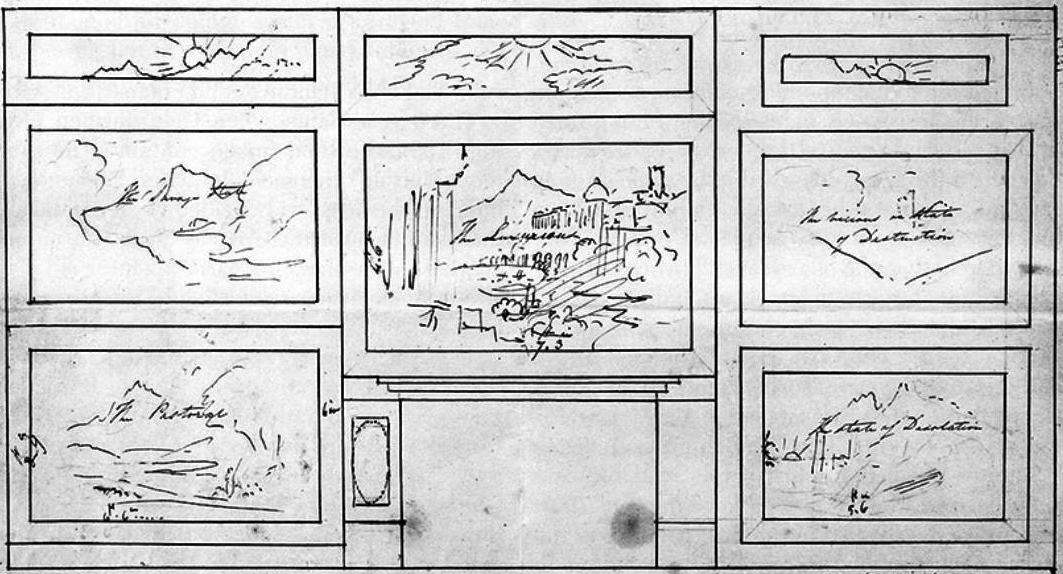
The paintings were designed to be hung around a fireplace in the picture gallery of a New York mansion on Greenwich Street in New York City. As shown in the design sketch below, they were arranged in a semi-circle or parabola, with three small canvases directly above depicting the morning, noontime and afternoon sun.

Titles:

  • The Savage State | The Arcadian or Pastoral State | The Consummation of Empire
  • Destruction | Desolation | Design for hanging the series

For those interested in exploring the fine detail of the paintings, the following site allows one to zoom, as well as to explore the works which inspired Cole: link (works best in Chrome or Firefox).

Ozymandias

Shelley and Smith, “Ozymandias”

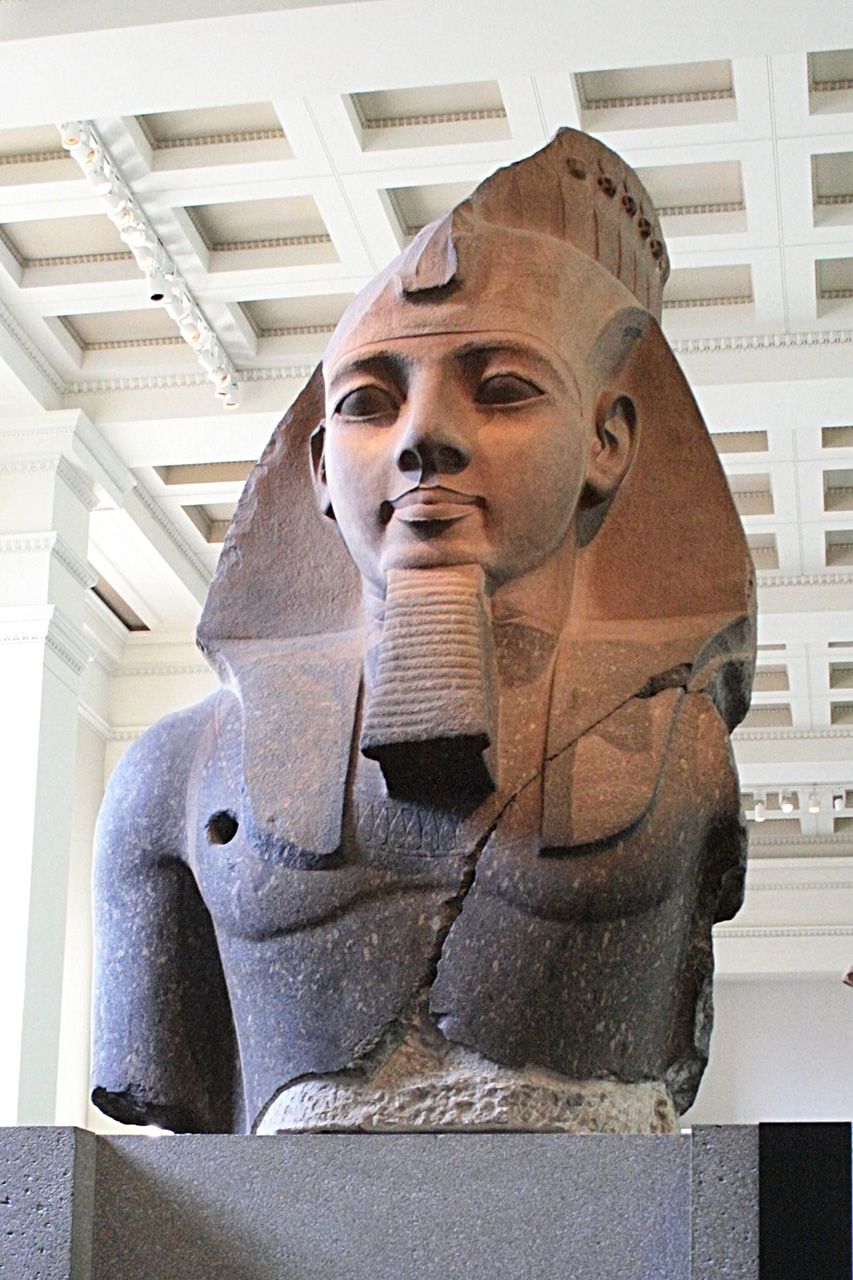
In December 1817, Horace Smith vacationed with Percy Bysshe Shelley and Mary Shelley (author of Frankenstein). During the holiday, news broke that a giant Egyptian bust of Ramesses II had been acquired for the British Museum by the Italian archaeologist Giovanni Belzoni. (Archaeology was then in its infancy: Belzoni, a former circus strong man, was less a scientist than a smash-and-grab antiques dealer; fifteen years earlier, Napoleon’s men had attempted to acquire the same sculpture for France, but it proved too bulky for extraction.) In a spirit of friendly rivalry Shelley and Smith agreed to write poems about Belzoni’s find, which at the time was just beginning the long voyage to London. Relying on written reports of the statue’s size, they drew also on the ancient Greek historian Diodorus Siculus, who described encountering a giant Egyptian statue with the inscription “King of Kings Ozymandias am I. If any want to know how great I am and where I lie, let him outdo me in my work.” (Note: Ozymandias is the Greek name for Ramesses.)

Percy Bysshe Shelley
Ozymandias

I met a traveller from an antique land
Who said: Two vast and trunkless legs of stone
Stand in the desart. Near them, on the sand,
Half sunk, a shattered visage lies, whose frown,
And wrinkled lip, and sneer of cold command,
Tell that its sculptor well those passions read
Which yet survive, stamped on these lifeless things,
The hand that mocked them and the heart that fed:
And on the pedestal these words appear:
“My name is Ozymandias, king of kings;
Look on my works, ye Mighty, and despair!”
Nothing beside remains. Round the decay
Of that colossal wreck, boundless and bare
The lone and level sands stretch far away.

Horace Smith
Ozymandias

In Egypt’s sandy silence, all alone,
Stands a gigantic Leg, which far off throws
The only shadow that the Desert knows:—
“I am great OZYMANDIAS,” saith the stone,
“The King of Kings; this mighty City shows
The wonders of my hand.”— The City’s gone,—
Naught but the Leg remaining to disclose
The site of this forgotten Babylon.
We wonder,—and some Hunter may express
Wonder like ours, when thro’ the wilderness
Where London stood, holding the Wolf in chace,
He meets some fragment huge, and stops to guess
What powerful but unrecorded race
Once dwelt in that annihilated place.

Citation:

  • Shelley, Percy Bysshe. “Ozymandias.” The Norton Anthology of Poetry, Third Ed. Edited by Alexander W. Allison, et al. W.W. Norton, 1983. p 619.
  • Smith, Horace. “Ozymandias.” Poem of the Week. potw.org/archive/potw192.html

Imagining Empire

Imagining Empire

Ancient empires were a recurring topos for the poets and artists of the nineteenth century. In reflecting on the magnificent art of a past age, they pondered the value of the humanities for present-day human beings. And in the great sweep of past human empires, they found a model for pondering the future of their own nations.

Note: we read these poems last semester. But I’m asking new questions about them.

Reading:

  • Percy Bysshe Shelley and Horace Smith, two poems titled “Ozymandias,” 1817 (link)
  • Thomas Cole, The Course of Empire series, 1833–1836 (link)

Writing: Respond to ONE of the following prompts. Keep your response short, posting as a reply under the appropriate heading in the comments section:

  1. All three artists powerfully evoke the era of decay after the fall of a great empire. What do their visions share in common? Alternatively, how do they differ? Either way, call our attention to a particular set of details.
  2. Just as in the preceding section, Shelley and Smith wrote these sonnets in response to an ancient work of art being shipped to England for display at the British Museum. Assuming that they can be read as speaking to that controversy, what do they seem to be saying? Focus on particular details from ONE poem or the other.

Debating Museums

Museums and the Legacy of Imperialism

The Parthenon Marbles were transported to Britain over the course of a decade beginning in 1801 under the direction of Lord Elgin, Britain’s ambassador to the Ottoman Empire. The Parthenon had lain in ruins for over a century, many of the sculptures from its marble frieze fallen to the ground after the building was used to store gunpowder and then struck by a shell during a war. Elgin claimed to have received permission for the dig from local Ottoman officials, and his ownership was ratified by Parliament when it purchased them for the Crown, designating the British Museum as trustee on the condition that the collection be displayed as the “Elgin Marbles.”

The presence of the marbles in London has been a matter of international debate since 1983, when the Greek parliament formally requested their return. Pressure intensified in 2009, when Greece completed construction of an on-site museum, and again in the run-up to the 2012 Olympics in London. As detailed in a NYTimes article, “The debate has only deepened in recent years as the actions of old empires have come under new scrutiny, and restitution battles have come to challenge the foundations of Western museums” (link). Some of these battles involve ancient artifacts like the Rosetta Stone, which Egypt in 2003 requested to be returned. Others involve ritual objects taken from living cultures, as for example the Benin Bronzes.

Viewing: some famous acquisitions to the British Museum during the nineteenth century.

Reading: recent NYTimes coverage of museums and the legacy of 19th century imperialism.

Writing: Respond to ONE of the following prompts. Keep your response short, posting as a reply under the appropriate heading in the comments section:

  1. What do the four images included above suggest about public enthusiasm toward archaeology back in the nineteenth century? To put it another way, what emotions do these images evoke: wonder? national pride? something else? In your response, focus our attention on particular details in ONE or at most TWO of the images.
  2. Click over to the British Museum excursion (top right) and use the embedded links to examine some of the artifacts you’ll have a chance to see on your visit. Focusing on one artifact in particular, why is it important for objects like this one to be on public display? What positive cultural function do museums serve in today’s society?
  3. The articles linked above all challenge the claim of museums to being the ideal repository of cultural artifacts. Citing one article in particular, paraphrase the critique being levied against museums.