1900 Paris Exposition

The Exposition Universelle

The 1900 Paris Exposition looked back upon a century of unprecedented technological and societal change. Transportation networks and global trade had knit the world together, stimulating cultural exchange. Coal had replaced water power, and by 1900 the streets of Paris and London were illuminated at night by electric lights.
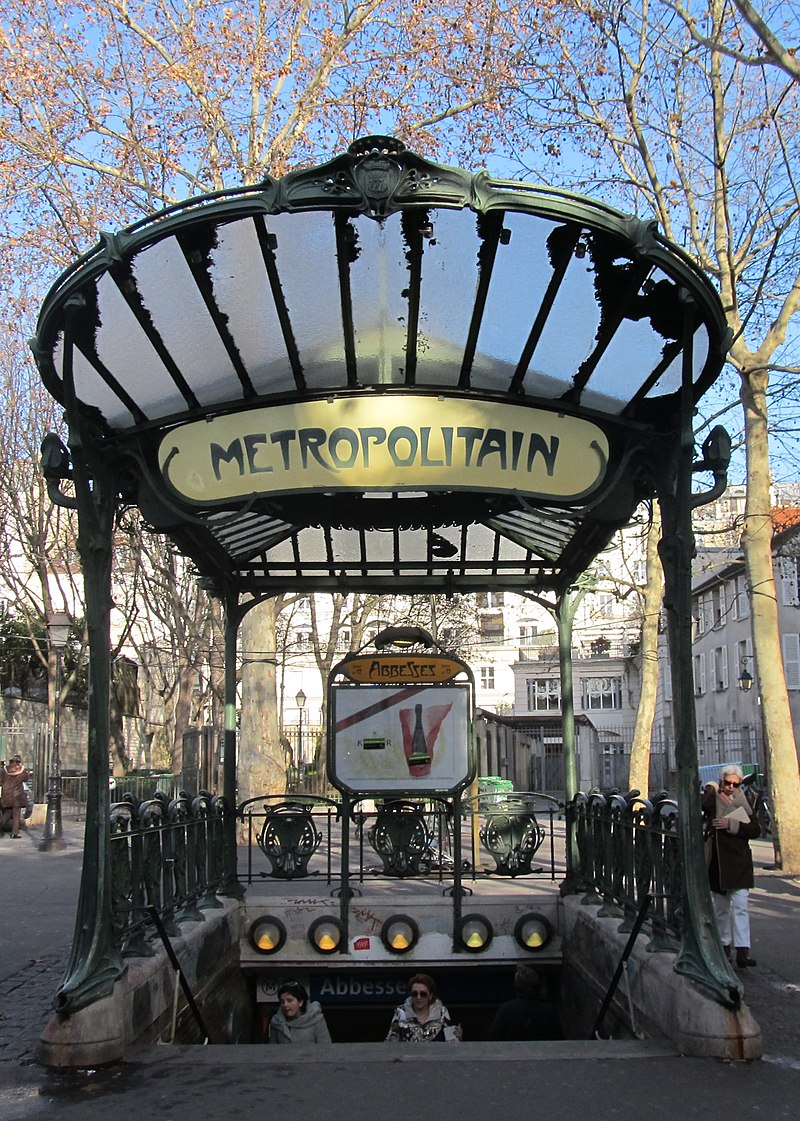
Eleven years earlier, Paris had wowed the world with the Eiffel Tower, built as the centerpiece of the 1889 Exposition. Though the 1900 fair may not have topped that wonder, timing it to correspond with the turn of the century gave it extraordinary symbolic heft. Exhibits ranged from technological marvels (moving sidewalks, a functioning x-ray machine, and a 187-foot-long telescope) to fine arts pavilions filled with contemporary sculptures and paintings. Britain, France and Holland all put up exhibits of featuring the fine arts and crafts of their colonial holdings from around the world.

Today, the only remaining traces of the 1900 Exposition are the Paris Metro entrances remodeled for the occasion in the Art Nouveau style. Photo at right (credit Iste Praetor 2012).

Reading: Strickland 89-91: “Architecture for the Industrial Age” and “Art Nouveau.”

Viewing: images from the Exposition Universelle, collected by Arthur Chandler for an online version of a 1987 article (link). The text of the article is interesting, but don’t feel obligated to do more than read bits connected to images you find striking.

Reading: The Exposition stimulated Henry Adams to write “The Dynamo and the Virgin,” a chapter from his memoir that ponders the driving force of the modern world—by contrast to that of the Middle Ages (link).

Viewing: In 1902 French film pioneer Georges Méliès premiered A Trip to the Moon. While based on a pair of Jules Verne stories from 1865 and 1870, many of the movie’s visuals strike me as referencing the giant telescope on view at the 1900 Exhibition (YouTube link).

Writing: Respond to ONE of the following prompts. Keep your response short, posting as a reply under the appropriate heading in the comments section:

  1. Point out a key contrast OR continuity between the 1889 Eiffel Tower and the Art Nouveau style of the 1900 Exposition.
  2. Adams’ essay is insightful, but also perplexing—starting with his choice to write about himself in the third person. Point out a striking idea or perplexing phrase as a basis for discussion.
  3. What themes stand out in Méliès’ depiction of humans venturing into space? Alternatively, what themes stand out in the movie’s depiction of the moon and its inhabitants?

Musée des Beaux Arts

W.H.Auden, “Musée des Beaux Arts”

Auden wrote this short poem in 1938, after a visit to the Royal Museum of Fine Arts in Belgium, inspired by its collection of paintings by the “Old Masters” of the Netherlandish Renaissance. The three paintings referenced in the poem are shown above: The Census at Bethlehem, The Massacre of the Innocents, and The Fall of Icarus. All are by Pieter Breughel the Elder and all date to the 1560s.

W.H.Auden
“Musée des Beaux Arts”

About suffering they were never wrong,
The Old Masters: how well they understood
Its human position; how it takes place
While someone else is eating or opening a window or just walking dully along;
How, when the aged are reverently, passionately waiting
For the miraculous birth, there always must be
Children who did not specially want it to happen, skating
On a pond at the edge of the wood:
They never forgot
That even the dreadful martyrdom must run its course
Anyhow in a corner, some untidy spot
Where the dogs go on with their doggy life and the torturer’s horse
Scratches its innocent behind on a tree.

In Breughel’s Icarus, for instance: how everything turns away
Quite leisurely from the disaster; the ploughman may
Have heard the splash, the forsaken cry,
But for him it was not an important failure; the sun shone
As it had to on the white legs disappearing into the green
Water; and the expensive delicate ship that must have seen
Something amazing, a boy falling out of the sky,
Had somewhere to get to and sailed calmly on.

Citation:

  • Auden, W. H. “Musée des Beaux Arts.” The Norton Anthology of Poetry, Third Ed. Edited by Alexander W. Allison, et al. W.W. Norton, 1983.

“Modern Greece”

Felicia Hemans was the daughter of a well-connected importer of Italian wines based in Liverpool and Wales. A gifted linguist and poet, she was acquainted with Wordsworth and Shelley. Though highly popular and widely read, her reputation declined in the decades after her death—a common plight of women writers in the 18th and 19th century. That trend has been reversed over the past thirty years, however, and her work now appears in many anthologies.

In 1817 Hemans anonymously published Modern Greece. Written in the metrical style of Byron’s Childe Harold from two years earlier, the poem was initially attributed to Byron, despite Hemans’ decidedly different attitude toward Lord Elgin’s seizure of the Parthenon Marbles, as shown in the following passage.

From Modern Greece
86      Oh! live there those who view with scornful eyes
     All that attests the brightness of thy prime?
     Yes; they who dwell beneath thy lovely skies,
     And breathe th’ inspiring ether of thy clime!
     Their path is o’er the mightiest of the dead,
     Their homes are midst the works of noblest arts;
     Yet all around their gaze, beneath their tread,
     Not one proud thrill of loftier thought imparts.
     Such are the conquerors of Minerva’s land,
Where Genius first reveal’d the triumphs of his hand!
thy prime: the poem is addressed to the land of Greece, great in its “prime,” but lying now in ruins

conquerors of Minerva’s land: the Turks, who conquered Athens in 1456.

87      For them in vain the glowing light may smile
     O’er the pale marble, colouring’s warmth to shed,
     And in chaste beauty many a sculptured pile
     Still o’er the dust of heroes lift its head.
     No patriot feeling binds them to the soil,
     Whose tombs and shrines their fathers have not rear’d,
     Their glance is cold indifference, and their toil
     But to destroy what ages have revered,
     As if exulting sternly to erase
Whate’er might prove that land had nurs’d a nobler race.
For them: the Turks
88      And who may grieve that, rescued from their hands,
     Spoilers of excellence and foes to art,
     Thy relics, Athens! borne to other lands,
     Claim homage still to thee from every heart?
     Though now no more th’ exploring stranger’s sight,
     Fix’d in deep reverence on Minerva’s fane,
     Shall hail, beneath their native heaven of light,
     All that remain’d of forms adored in vain;
     A few short years—and, vanish’d from the scene,
To blend with classic dust their proudest lot had been.
89      Fair Parthenon! yet still must fancy weep
     For thee, thou work of nobler spirits flown.
     Bright, as of old, the sunbeams o’er thee sleep
     In all their beauty still—and thine is gone!
     Empires have sunk since thou wert first revered,
     And varying rites have sanctified thy shrine.
     The dust is round thee of the race that rear’d
     Thy walls; and thou—their fate must soon be thine!
     But when shall earth again exult to see
Visions divine like theirs renew’d in aught like thee?

Citation: Hemans, Felicia. Modern Greece, 1817. Text from Project Gutenberg, 2021. Edited by Charles Henebry, 2023. hum104.commacafe.org/modern-greece

“Childe Harold’s Pilgrimage”

A close friend of Shelley, the Romantic poet Lord Byron himself embodied many of the qualities of the Romantic hero: brilliant, moody, driven. His thirst for fresh experience sent him on travels around Europe, and he spent much of his adult life in Italy and Greece. He died in 1824 fighting in the Greek War of Independence against the Ottoman Turks.

In 1815 Byron published the first two parts of a semi-autobiographical poem titled Childe Harold’s Pilgrimage. Its second canto opens on the steps of the Parthenon in Athens. The ruin occasions a meditation on religion and the sweep of history, ending with a forceful condemnation of Lord Elgin’s looting of the temple’s marble frieze.

From Canto the Second
1      Come, blue-eyed maid of heaven!—but thou, alas,
     Didst never yet one mortal song inspire—
     Goddess of Wisdom! here thy temple was,
     And is, despite of war and wasting fire,
     And years, that bade thy worship to expire:
     But worse than steel, and flame, and ages slow,
     Is the drear sceptre and dominion dire
     Of men who never felt the sacred glow
That thoughts of thee and thine on polished breasts bestow.
2      Ancient of days! august Athena! where,
     Where are thy men of might, thy grand in soul?
     Gone—glimmering through the dream of things that were:
     First in the race that led to Glory’s goal,
     They won, and passed away—is this the whole?
     A schoolboy’s tale, the wonder of an hour!
     The warrior’s weapon and the sophist’s stole
     Are sought in vain, and o’er each mouldering tower,
Dim with the mist of years, grey flits the shade of power.
3      Son of the morning, rise! approach you here!
     Come—but molest not yon defenceless urn!
     Look on this spot—a nation’s sepulchre!
     Abode of gods, whose shrines no longer burn.
     E’en gods must yield—religions take their turn:
     ‘Twas Jove’s—’tis Mahomet’s; and other creeds
     Will rise with other years, till man shall learn
     Vainly his incense soars, his victim bleeds;
Poor child of Doubt and Death, whose hope is built on reeds.
….
6      Look on its broken arch, its ruined wall,
     Its chambers desolate, and portals foul:
     Yes, this was once Ambition’s airy hall,
     The dome of Thought, the Palace of the Soul.
     Behold through each lack-lustre, eyeless hole,
     The gay recess of Wisdom and of Wit,
     And Passion’s host, that never brooked control:
     Can all saint, sage, or sophist ever writ,
People this lonely tower, this tenement refit?
….
10      Here let me sit upon this mossy stone,
     The marble column’s yet unshaken base!
     Here, son of Saturn, was thy favourite throne!
     Mightiest of many such! Hence let me trace
     The latent grandeur of thy dwelling-place.
     It may not be: nor even can Fancy’s eye
     Restore what time hath laboured to deface.
     Yet these proud pillars claim no passing sigh;
Unmoved the Moslem sits, the light Greek carols by.
11      But who, of all the plunderers of yon fane
     On high, where Pallas lingered, loth to flee
     The latest relic of her ancient reign—
     The last, the worst, dull spoiler, who was he?
     Blush, Caledonia! such thy son could be!
     England! I joy no child he was of thine:
     Thy free-born men should spare what once was free;
     Yet they could violate each saddening shrine,
And bear these altars o’er the long reluctant brine.
Caledonia: Scotland
12      But most the modern Pict’s ignoble boast,
     To rive what Goth, and Turk, and Time hath spared:
     Cold as the crags upon his native coast,
     His mind as barren and his heart as hard,
     Is he whose head conceived, whose hand prepared,
     Aught to displace Athena’s poor remains:
     Her sons too weak the sacred shrine to guard,
     Yet felt some portion of their mother’s pains,
And never knew, till then, the weight of Despot’s chains.
Picts: a barbarous tribe in ancient Scotland
13      What! shall it e’er be said by British tongue
     Albion was happy in Athena’s tears?
     Though in thy name the slaves her bosom wrung,
     Tell not the deed to blushing Europe’s ears;
     The ocean queen, the free Britannia, bears
     The last poor plunder from a bleeding land:
     Yes, she, whose generous aid her name endears,
     Tore down those remnants with a harpy’s hand.
Which envious eld forbore, and tyrants left to stand.
14      Where was thine aegis, Pallas, that appalled
     Stern Alaric and Havoc on their way?
     Where Peleus’ son? whom Hell in vain enthralled,
     His shade from Hades upon that dread day
     Bursting to light in terrible array!
     What! could not Pluto spare the chief once more,
     To scare a second robber from his prey?
     Idly he wandered on the Stygian shore,
Nor now preserved the walls he loved to shield before.
Alaric: Visigoth king who unsuccessfully invaded Greece

Peleus: father of Achilles

15      Cold is the heart, fair Greece, that looks on thee,
     Nor feels as lovers o’er the dust they loved;
     Dull is the eye that will not weep to see
     Thy walls defaced, thy mouldering shrines removed
     By British hands, which it had best behoved
     To guard those relics ne’er to be restored.
     Curst be the hour when from their isle they roved,
     And once again thy hapless bosom gored,
And snatched thy shrinking gods to northern climes abhorred!

Citation: Byron, George Gordon Byron, Baron. Childe Harold’s Pilgrimage, 1815. Text from Project Gutenberg, 2013. Edited by Charles Henebry, 2023. hum104.commacafe.org/childe-harolds-pilgrimage

George the Poet

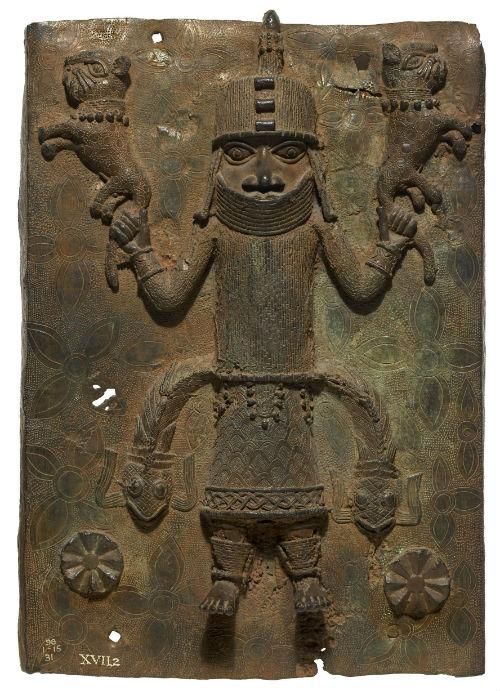
George the Poet, “The Benin Bronzes”

The Benin Bronzes were created for the Royal Court of Benin, an African kingdom that prospered through trade with the Portuguese and other Europeans from the 16th century onward. But in the late 19th century, at a time when the British had come to dominate the West African trade, tensions over the expanded European presence in Africa led to a bloody war and occupation. In the course of pillaging Benin city, these magnificent bronze artworks honoring the kings’ ancestral line were plundered. Many of them are now on display at the British Museum, though some are scattered in other museums around the world. The Nigerian National Commission for Museums and Monuments is in talks with the British Museum about repatriating these artifacts: details on this history and on the current status of negotiations here.

In 2015, as part of the Museum’s “Huge History Lesson” challenge, George the Poet produced the following piece.

On Seeing the Elgin Marbles

In 1817, John Keats saw the Parthenon Marbles, then newly on display at the British Museum. At the time, the Museum was only open to visitors by special arrangement, and Keats visited in the company of the painter Benjamin Robert Haydon, a spirited defender of Parliament’s 1816 decision to buy the Parthenon marbles from Lord Elgin and place them on display at the museum (link). A week later, he published the following two poems in The Examiner:

To Haydon
Haydon! Forgive me, that I cannot speak
Definitively on these mighty things;
Forgive me that I have not Eagle’s wings—
That what I want I know not where to seek:
And think that I would not be over meek
In rolling out upfollow’d thunderings,
Even to the steep of Helciconian springs,
Were I of ample strength for such a freak—
Think too that all those numbers should be thine;
Whose else? In this who touch thy vesture’s hem?
For when men star’d at what was most divine
With browless idiotism—o’erwise phlegm—
Thou hadst beheld the Hesperean shine
Of their star in the East, and gone to worship them.

On Seeing the Elgin Marbles
My spirit is too weak—mortality
Weighs heavily on me like unwilling sleep,
And each imagined pinnacle and steep
Of godlike hardship tells me I must die
Like a sick eagle looking at the sky.
Yet ’tis a gentle luxury to weep
That I have not the cloudy winds to keep
Fresh for the opening of the morning’s eye.
Such dim-conceived glories of the brain
Bring round the heart an undescribable feud;
So do these wonders a most dizzy pain,
That mingles Grecian grandeur with the rude
Wasting of old time—with a billowy main—
A sun—a shadow of a magnitude.

The Course of Empire

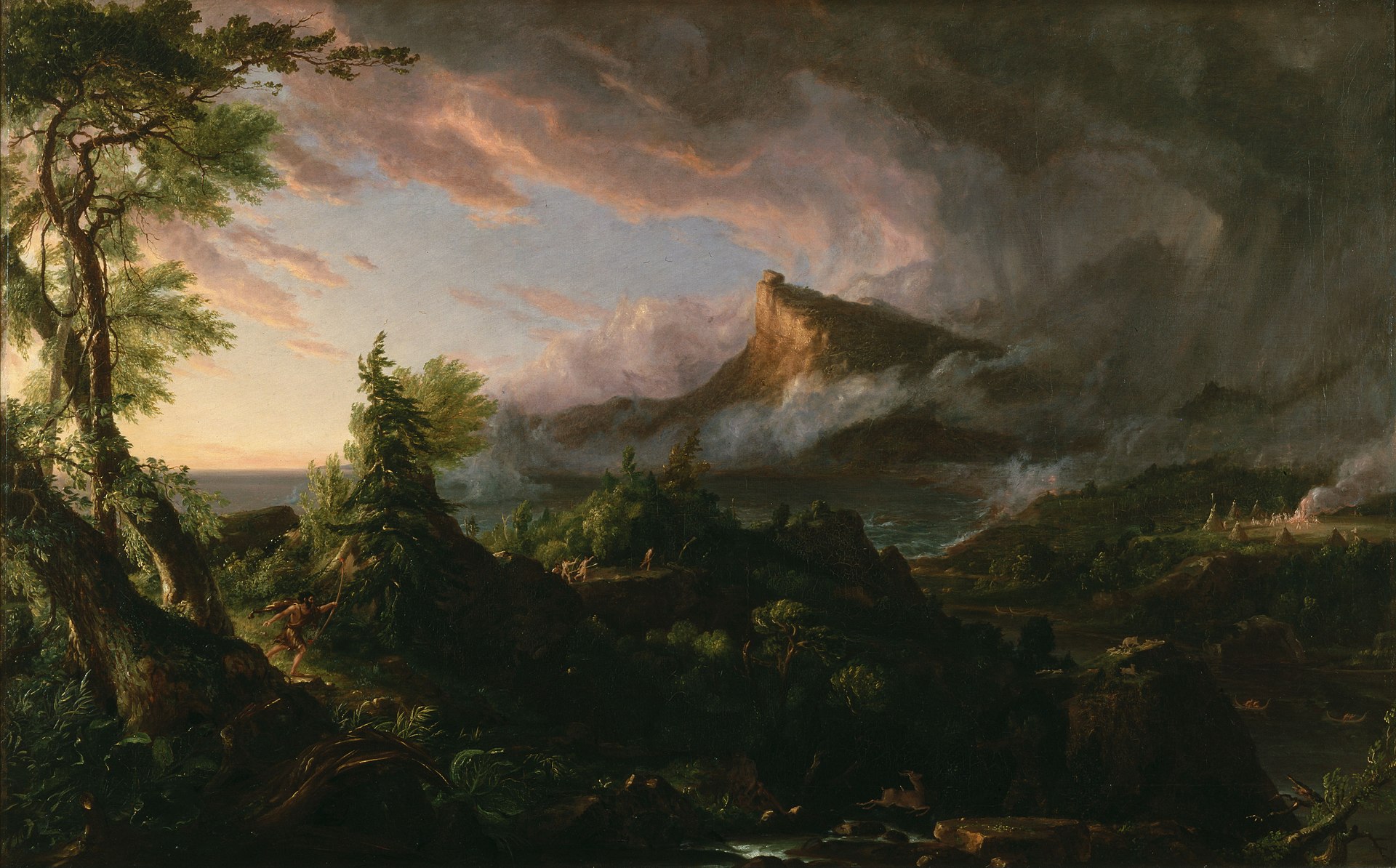
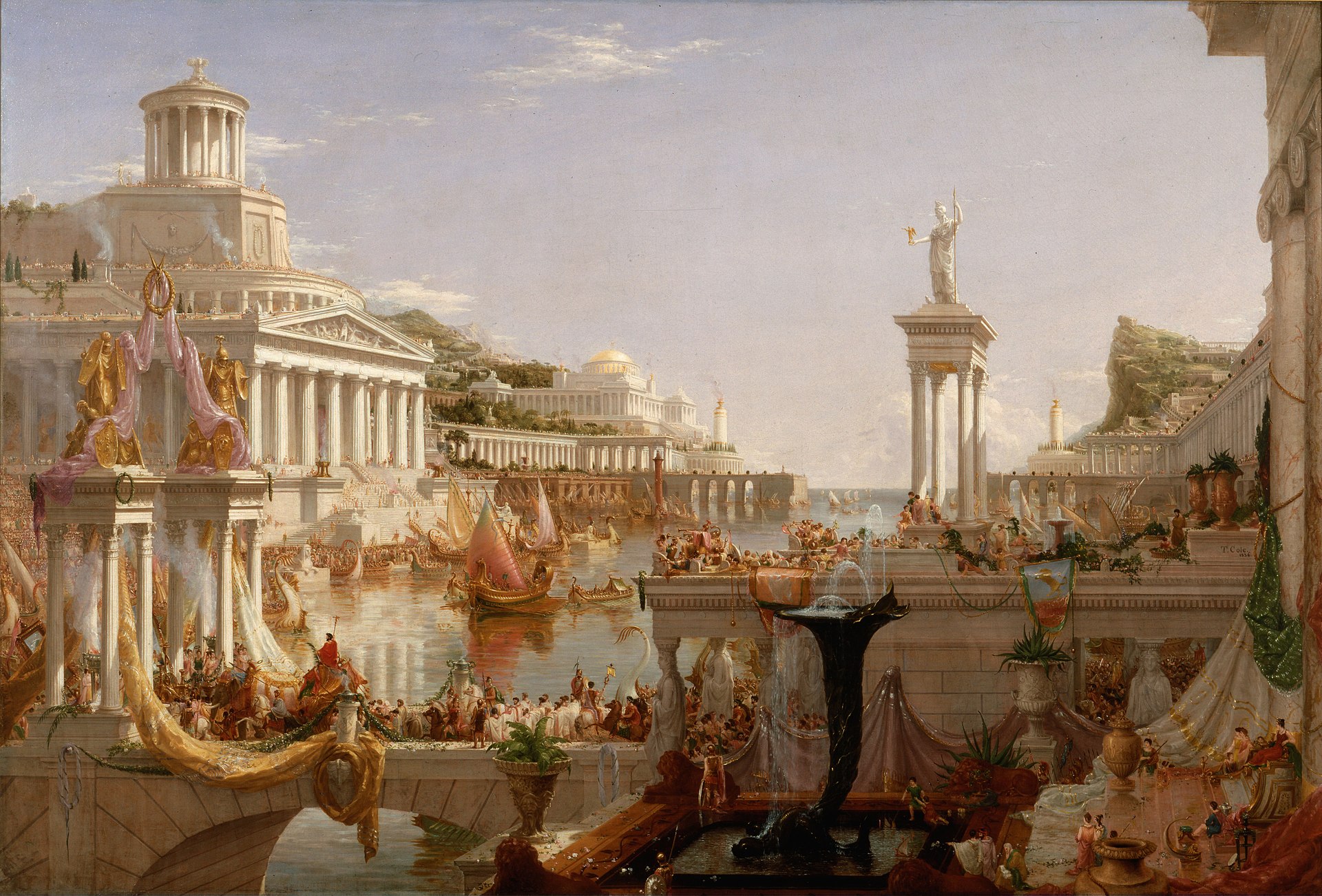
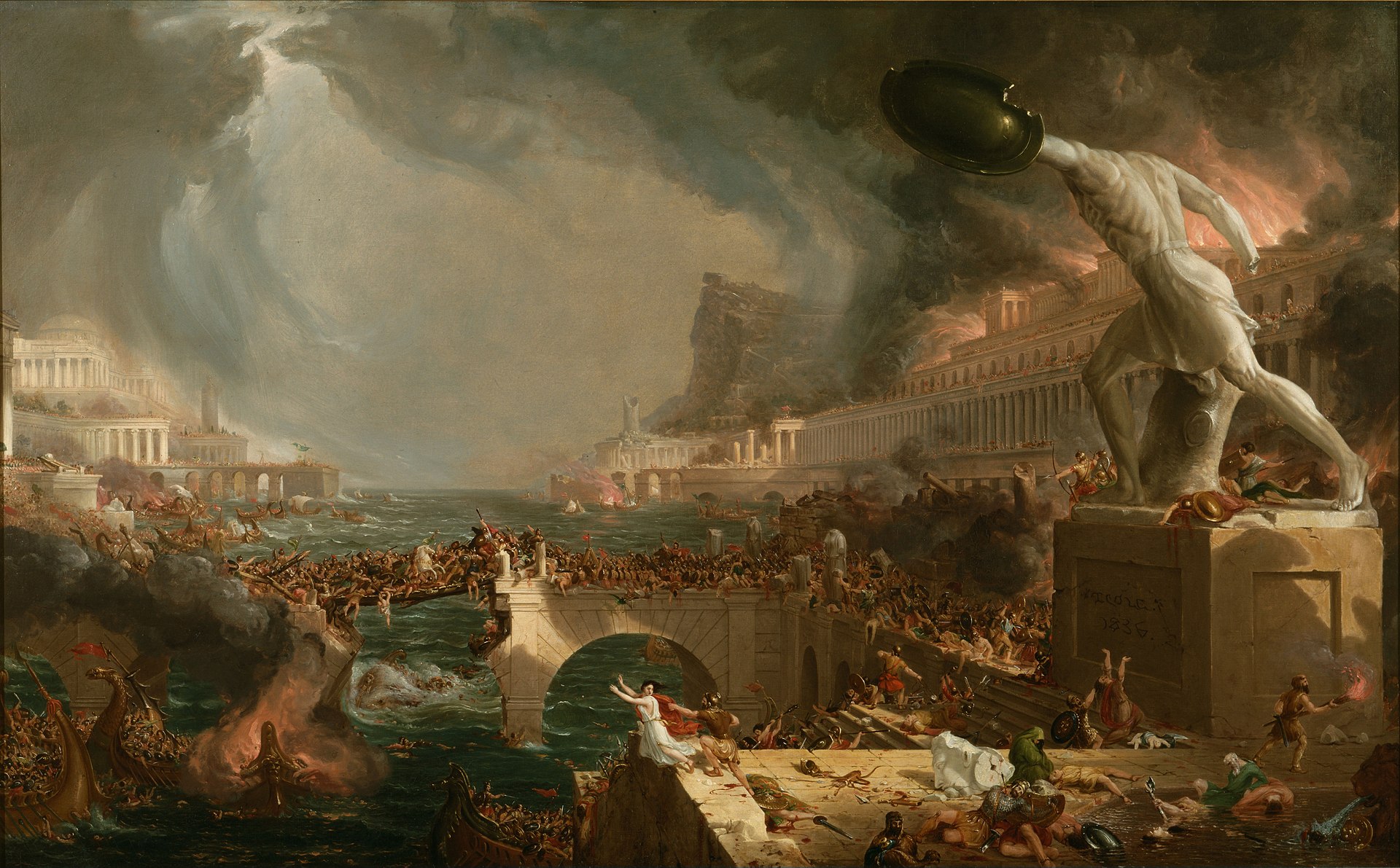
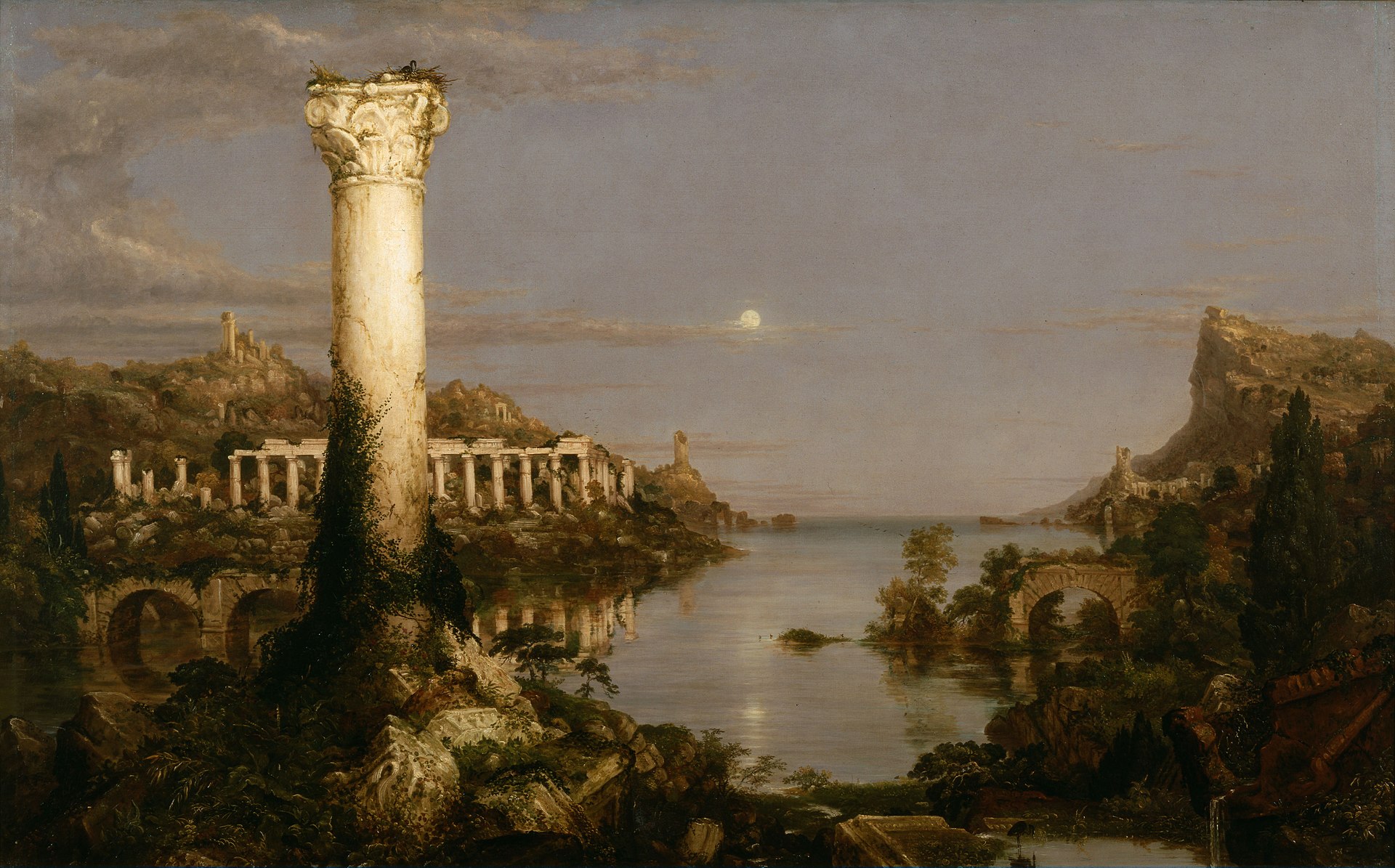
Between 1833 and 1836, Thomas Cole produced a series of five paintings presenting human civilization as having both a rising and a falling phase. Born in England, Cole emigrated to America at 17, and rose to prominence as a leading member of the Hudson River School, painting Romantic history and landscape paintings that sold to prosperous New York businessmen.

Cole’s presentation of civilization in this series undoubtedly reflects American anxieties as to the destiny of that nation, just then emerging from the pastoral stage to material prosperity. Yet similar ideas about the cycle of history can be found in the poetry of English Romantic poets like Shelley and Byron.

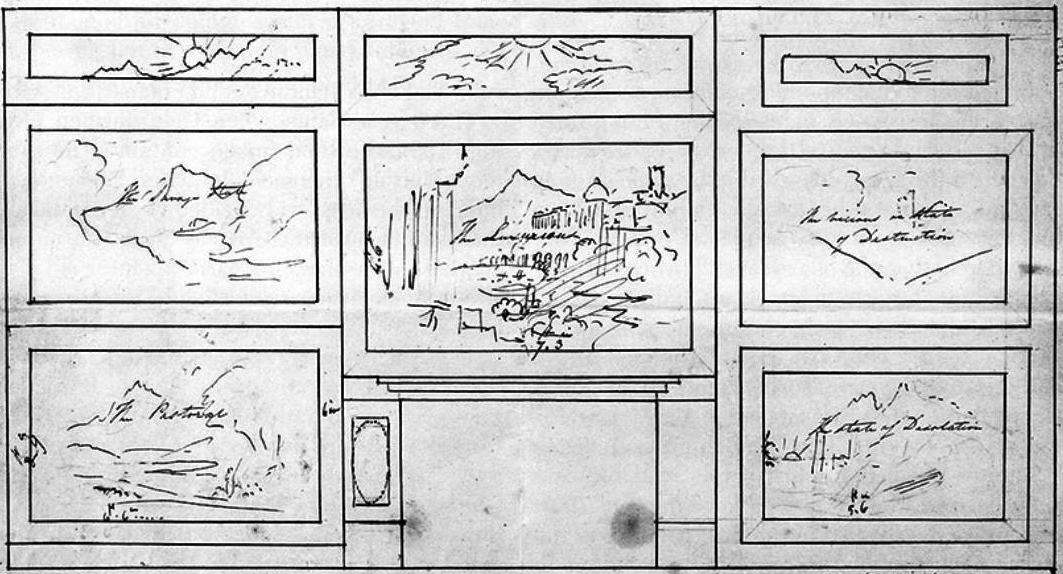
The paintings were designed to be hung around a fireplace in the picture gallery of a New York mansion on Greenwich Street in New York City. As shown in the design sketch below, they were arranged in a semi-circle or parabola, with three small canvases directly above depicting the morning, noontime and afternoon sun.

Titles:

  • The Savage State | The Arcadian or Pastoral State | The Consummation of Empire
  • Destruction | Desolation | Design for hanging the series

For those interested in exploring the fine detail of the paintings, the following site allows one to zoom, as well as to explore the works which inspired Cole: link (works best in Chrome or Firefox).

Ode on a Grecian Urn

John Keats, “Ode on a Grecian Urn”

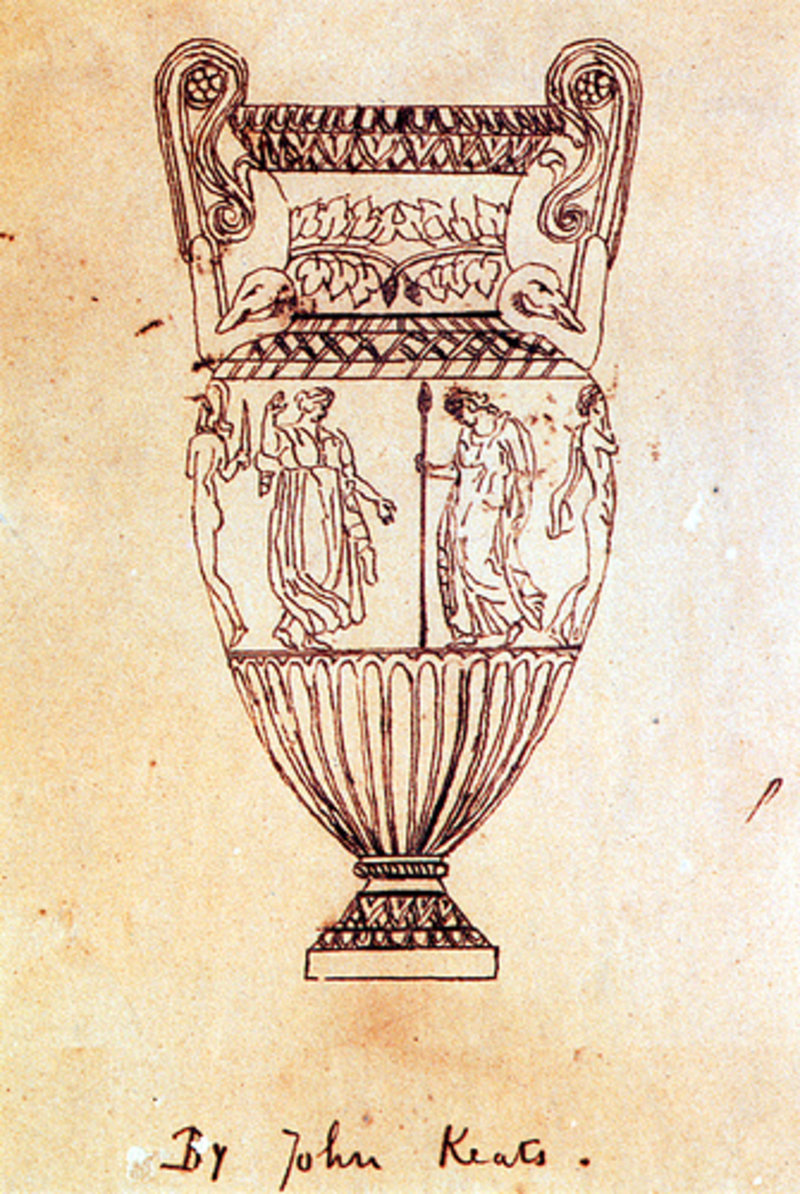
In 1819, Keats sketched the urn shown at right from a book of engravings. The original, a famous piece by the ancient Greek Sosibios, was (and is) on display at the Louvre. The same year, Keats wrote the following poem.

John Keats
Ode on a Grecian Urn

Thou still unravish’d bride of quietness,
Thou foster-child of silence and slow time,
Sylvan historian, who canst thus express
A flowery tale more sweetly than our rhyme:
What leaf-fring’d legend haunts about thy shape
Of deities or mortals, or of both,
In Tempe or the dales of Arcady?
What men or gods are these? What maidens loth?
What mad pursuit? What struggle to escape?
What pipes and timbrels? What wild ecstasy?

Heard melodies are sweet, but those unheard
Are sweeter; therefore, ye soft pipes, play on;
Not to the sensual ear, but, more endear’d,
Pipe to the spirit ditties of no tone:
Fair youth, beneath the trees, thou canst not leave
Thy song, nor ever can those trees be bare;
Bold Lover, never, never canst thou kiss,
Though winning near the goal yet, do not grieve;
She cannot fade, though thou hast not thy bliss,
For ever wilt thou love, and she be fair!

Ah, happy, happy boughs! that cannot shed
Your leaves, nor ever bid the Spring adieu;
And, happy melodist, unwearied,
For ever piping songs for ever new;
More happy love! more happy, happy love!
For ever warm and still to be enjoy’d,
For ever panting, and for ever young;
All breathing human passion far above,
That leaves a heart high-sorrowful and cloy’d,
A burning forehead, and a parching tongue.

Who are these coming to the sacrifice?
To what green altar, O mysterious priest,
Lead’st thou that heifer lowing at the skies,
And all her silken flanks with garlands drest?
What little town by river or sea shore,
Or mountain-built with peaceful citadel,
Is emptied of this folk, this pious morn?
And, little town, thy streets for evermore
Will silent be; and not a soul to tell
Why thou art desolate, can e’er return.

O Attic shape! Fair attitude! with brede
Of marble men and maidens overwrought,
With forest branches and the trodden weed;
Thou, silent form, dost tease us out of thought
As doth eternity: Cold Pastoral!
When old age shall this generation waste,
Thou shalt remain, in midst of other woe
Than ours, a friend to man, to whom thou say’st,
“Beauty is truth, truth beauty,—that is all
Ye know on earth, and all ye need to know.”

Citation:

  • Keats, John. “Ode on a Grecian Urn.” The Norton Anthology of Poetry, Third Ed. Edited by Alexander W. Allison, et al. W.W. Norton, 1983. pp 663-4.

Ozymandias

Shelley and Smith, “Ozymandias”

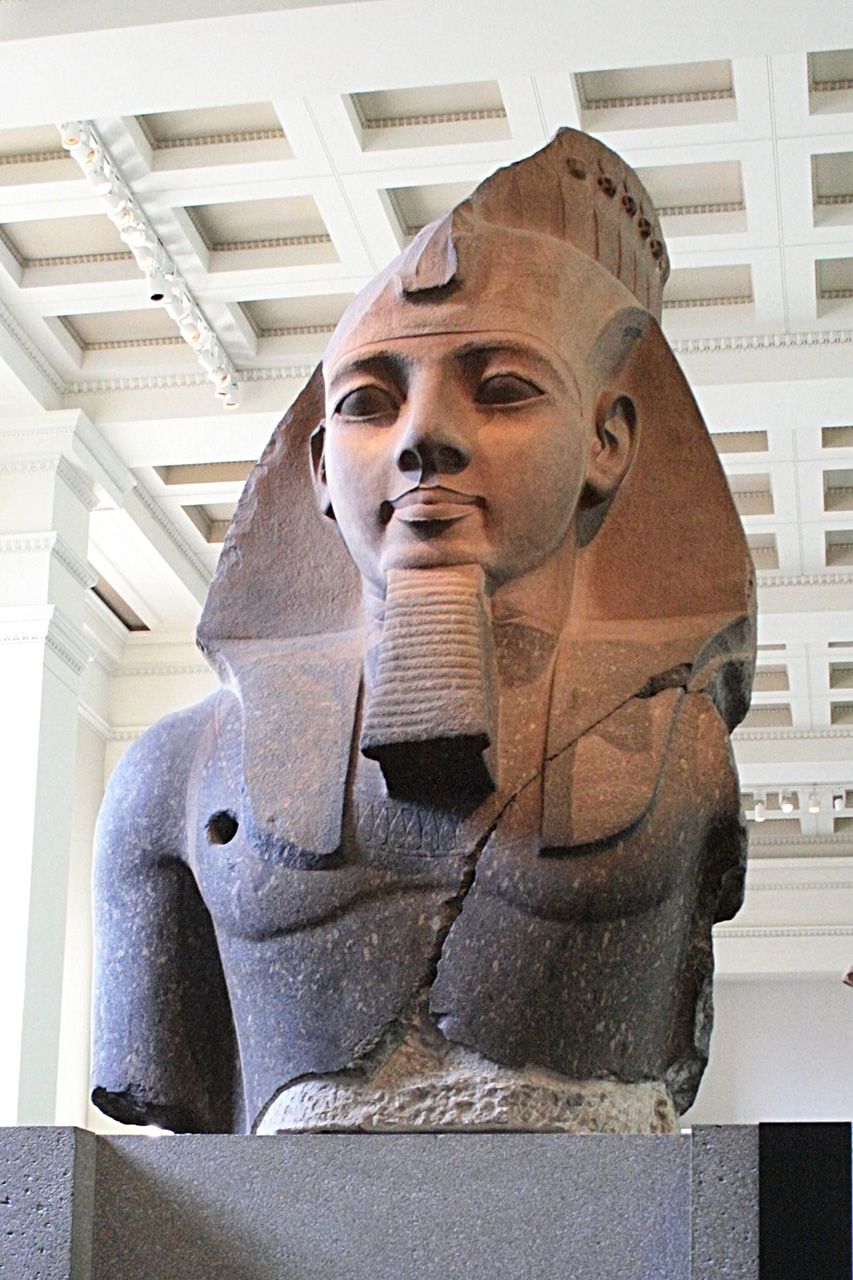
In December 1817, Horace Smith vacationed with Percy Bysshe Shelley and Mary Shelley (author of Frankenstein). During the holiday, news broke that a giant Egyptian bust of Ramesses II had been acquired for the British Museum by the Italian archaeologist Giovanni Belzoni. (Archaeology was then in its infancy: Belzoni, a former circus strong man, was less a scientist than a smash-and-grab antiques dealer; fifteen years earlier, Napoleon’s men had attempted to acquire the same sculpture for France, but it proved too bulky for extraction.) In a spirit of friendly rivalry Shelley and Smith agreed to write poems about Belzoni’s find, which at the time was just beginning the long voyage to London. Relying on written reports of the statue’s size, they drew also on the ancient Greek historian Diodorus Siculus, who described encountering a giant Egyptian statue with the inscription “King of Kings Ozymandias am I. If any want to know how great I am and where I lie, let him outdo me in my work.” (Note: Ozymandias is the Greek name for Ramesses.)

Percy Bysshe Shelley
Ozymandias

I met a traveller from an antique land
Who said: Two vast and trunkless legs of stone
Stand in the desart. Near them, on the sand,
Half sunk, a shattered visage lies, whose frown,
And wrinkled lip, and sneer of cold command,
Tell that its sculptor well those passions read
Which yet survive, stamped on these lifeless things,
The hand that mocked them and the heart that fed:
And on the pedestal these words appear:
“My name is Ozymandias, king of kings;
Look on my works, ye Mighty, and despair!”
Nothing beside remains. Round the decay
Of that colossal wreck, boundless and bare
The lone and level sands stretch far away.

Horace Smith
Ozymandias

In Egypt’s sandy silence, all alone,
Stands a gigantic Leg, which far off throws
The only shadow that the Desert knows:—
“I am great OZYMANDIAS,” saith the stone,
“The King of Kings; this mighty City shows
The wonders of my hand.”— The City’s gone,—
Naught but the Leg remaining to disclose
The site of this forgotten Babylon.
We wonder,—and some Hunter may express
Wonder like ours, when thro’ the wilderness
Where London stood, holding the Wolf in chace,
He meets some fragment huge, and stops to guess
What powerful but unrecorded race
Once dwelt in that annihilated place.

Citation:

  • Shelley, Percy Bysshe. “Ozymandias.” The Norton Anthology of Poetry, Third Ed. Edited by Alexander W. Allison, et al. W.W. Norton, 1983. p 619.
  • Smith, Horace. “Ozymandias.” Poem of the Week. potw.org/archive/potw192.html