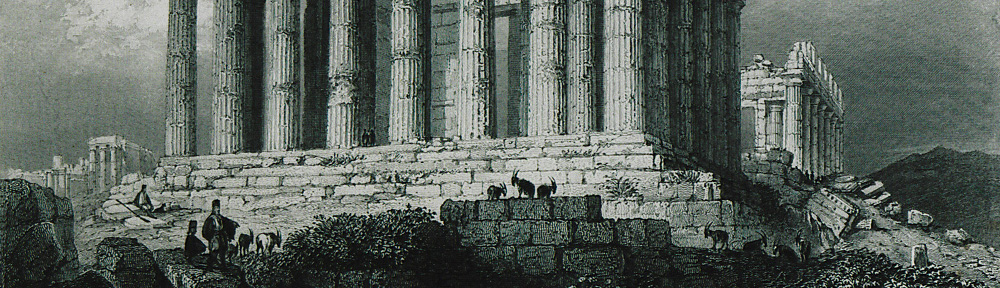
A close friend of Shelley, the Romantic poet Lord Byron himself embodied many of the qualities of the Romantic hero: brilliant, moody, driven. His thirst for fresh experience sent him on travels around Europe, and he spent much of his adult life in Italy and Greece. He died in 1824 fighting in the Greek War of Independence against the Ottoman Turks.
In 1815 Byron published the first two parts of a semi-autobiographical poem titled Childe Harold’s Pilgrimage. Its second canto opens on the steps of the Parthenon in Athens. The ruin occasions a meditation on religion and the sweep of history, ending with a forceful condemnation of Lord Elgin’s looting of the temple’s marble frieze.
| From Canto the Second | ||
| 1 | Come, blue-eyed maid of heaven!—but thou, alas, Didst never yet one mortal song inspire— Goddess of Wisdom! here thy temple was, And is, despite of war and wasting fire, And years, that bade thy worship to expire: But worse than steel, and flame, and ages slow, Is the drear sceptre and dominion dire Of men who never felt the sacred glow That thoughts of thee and thine on polished breasts bestow. |
|
| 2 | Ancient of days! august Athena! where, Where are thy men of might, thy grand in soul? Gone—glimmering through the dream of things that were: First in the race that led to Glory’s goal, They won, and passed away—is this the whole? A schoolboy’s tale, the wonder of an hour! The warrior’s weapon and the sophist’s stole Are sought in vain, and o’er each mouldering tower, Dim with the mist of years, grey flits the shade of power. |
|
| 3 | Son of the morning, rise! approach you here! Come—but molest not yon defenceless urn! Look on this spot—a nation’s sepulchre! Abode of gods, whose shrines no longer burn. E’en gods must yield—religions take their turn: ‘Twas Jove’s—’tis Mahomet’s; and other creeds Will rise with other years, till man shall learn Vainly his incense soars, his victim bleeds; Poor child of Doubt and Death, whose hope is built on reeds. |
|
| …. | ||
| 6 | Look on its broken arch, its ruined wall, Its chambers desolate, and portals foul: Yes, this was once Ambition’s airy hall, The dome of Thought, the Palace of the Soul. Behold through each lack-lustre, eyeless hole, The gay recess of Wisdom and of Wit, And Passion’s host, that never brooked control: Can all saint, sage, or sophist ever writ, People this lonely tower, this tenement refit? |
|
| …. | ||
| 10 | Here let me sit upon this mossy stone, The marble column’s yet unshaken base! Here, son of Saturn, was thy favourite throne! Mightiest of many such! Hence let me trace The latent grandeur of thy dwelling-place. It may not be: nor even can Fancy’s eye Restore what time hath laboured to deface. Yet these proud pillars claim no passing sigh; Unmoved the Moslem sits, the light Greek carols by. |
|
| 11 | But who, of all the plunderers of yon fane On high, where Pallas lingered, loth to flee The latest relic of her ancient reign— The last, the worst, dull spoiler, who was he? Blush, Caledonia! such thy son could be! England! I joy no child he was of thine: Thy free-born men should spare what once was free; Yet they could violate each saddening shrine, And bear these altars o’er the long reluctant brine. |
Caledonia: Scotland |
| 12 | But most the modern Pict’s ignoble boast, To rive what Goth, and Turk, and Time hath spared: Cold as the crags upon his native coast, His mind as barren and his heart as hard, Is he whose head conceived, whose hand prepared, Aught to displace Athena’s poor remains: Her sons too weak the sacred shrine to guard, Yet felt some portion of their mother’s pains, And never knew, till then, the weight of Despot’s chains. |
Picts: a barbarous tribe in ancient Scotland |
| 13 | What! shall it e’er be said by British tongue Albion was happy in Athena’s tears? Though in thy name the slaves her bosom wrung, Tell not the deed to blushing Europe’s ears; The ocean queen, the free Britannia, bears The last poor plunder from a bleeding land: Yes, she, whose generous aid her name endears, Tore down those remnants with a harpy’s hand. Which envious eld forbore, and tyrants left to stand. |
|
| 14 | Where was thine aegis, Pallas, that appalled Stern Alaric and Havoc on their way? Where Peleus’ son? whom Hell in vain enthralled, His shade from Hades upon that dread day Bursting to light in terrible array! What! could not Pluto spare the chief once more, To scare a second robber from his prey? Idly he wandered on the Stygian shore, Nor now preserved the walls he loved to shield before. |
Alaric: Visigoth king who unsuccessfully invaded Greece
Peleus: father of Achilles |
| 15 | Cold is the heart, fair Greece, that looks on thee, Nor feels as lovers o’er the dust they loved; Dull is the eye that will not weep to see Thy walls defaced, thy mouldering shrines removed By British hands, which it had best behoved To guard those relics ne’er to be restored. Curst be the hour when from their isle they roved, And once again thy hapless bosom gored, And snatched thy shrinking gods to northern climes abhorred! |
Citation: Byron, George Gordon Byron, Baron. Childe Harold’s Pilgrimage, 1815. Text from Project Gutenberg, 2013. Edited by Charles Henebry, 2023. hum104.commacafe.org/childe-harolds-pilgrimage