
Jul 2
Thinking about Museums
Our classes meet for 2 hours; I plan to cover several distinct topics in each class—usually two topics in total. For convenience, these topics are hidden when this page is first loaded; click on the + to unfold them. Prior to class, make sure to open, read, and respond to ALL items labelled as “Class Prep”; items labelled as “In Class” are presented here only so you can find them later in the semester. Note that each Class Prep section has its own HW assignment; you should complete BOTH Class Prep sections.
For the “Museum Reflection,” due in two weeks, you will visit the British Museum. So I want to focus in our first class on the cultural function of that institution. Established in 1753 as a cabinet of natural curiosities (fossils, preserved specimens, and the like), the museum became a repository for art and cultural artifacts beginning in the early 1800s, as British victory in the Napoleonic wars brought to London a trove of objects from ancient Egypt and Greece. The collection grew enormously over the next two hundred years. Today the vast collection of the British Museum stands as testament to Britain’s imperial might from 1800-1950.
The two “Class Prep” sections, below, offer contrasting answers to the question, “What is the cultural function of a museum?” The first gives a roundly positive answer; the second a far more negative account. Your task in the Museum Reflection assignment will be to reflect on these contrasting perspectives, and perhaps give an answer all your own. Today’s HW starts you on the process of that reflection—be sure to do both sections marked “Class Prep.”
Museums and the Legacy of Imperialism
The Parthenon Marbles were transported to Britain over the course of a decade beginning in 1801 under the direction of Lord Elgin, Britain’s ambassador to the Ottoman Empire. The Parthenon had lain in ruins for over a century, many of the sculptures from its marble frieze fallen to the ground after the building was used to store gunpowder and then struck by a shell during a war. Elgin claimed to have received permission for the dig from local Ottoman officials, and his ownership was ratified by Parliament when it purchased them for the Crown, designating the British Museum as trustee on the condition that the collection be displayed as the “Elgin Marbles.”
The presence of the marbles in London has been a matter of international debate since 1983, when the Greek parliament formally requested their return. Pressure intensified in 2009, when Greece completed construction of an on-site museum, and again in the run-up to the 2012 Olympics in London. As detailed in a NYTimes article, “The debate has only deepened in recent years as the actions of old empires have come under new scrutiny, and restitution battles have come to challenge the foundations of Western museums” (link). Some of these battles involve ancient artifacts like the Rosetta Stone, which Egypt in 2003 requested to be returned. Others involve ritual objects taken from living cultures, as for example the Benin Bronzes.
Viewing: some famous acquisitions to the British Museum during the nineteenth century.
-

- The Temporary Elgin Room, 1819

-
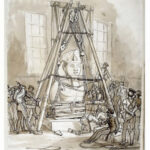
- Installing the Bust of Ramesses II, 1834

-

- “Reception of Nineveh Sculptures , 1852

-

- British soldiers with looted art in Benin, 1897

Reading: recent NYTimes coverage of museums and the legacy of 19th century imperialism.
- “The Masterpieces That Napoleon Stole, and How Some Went Back,” by Farah Nayeri for the NYTimes
- “For U.S. Museums With Looted Art, the Indiana Jones Era Is Over” by Graham Bowley for the NYTimes
- “To Protest Colonialism, He Takes Artifacts From Museums,” by Farah Nayeri for the NYTimes
Writing: Respond to ONE of the following prompts. Keep your response short, posting as a reply under the appropriate heading in the comments section:
- What do the four images included above suggest about public enthusiasm toward archaeology back in the nineteenth century? To put it another way, what emotions do these images evoke: wonder? national pride? something else? In your response, focus our attention on particular details in ONE or at most TWO of the images.
- Click over to the British Museum excursion (top right) and use the embedded links to examine some of the artifacts you’ll have a chance to see on your visit. Focusing on one artifact in particular, why is it important for objects like this one to be on public display? What positive cultural function do museums serve in today’s society?
- The articles linked above all challenge the claim of museums to being the ideal repository of cultural artifacts. Citing one article in particular, paraphrase the critique being levied against museums.
Show/Hide Museum Encounters HW
Show/Hide Debating Museums HW
Moments of Surprise
⤹Click the reply button just below.
Encounters with Deep Time
⤹Click the reply button just below.
Unused Question (should be invisible)
⤹Click the reply button just below.
Archaeology in the 19th Century
⤹Click the reply button just below.
The Cultural Function of Museums Today
⤹Click the reply button just below.
Critiquing Museums
⤹Click the reply button just below.