Everybody Comes to Rick’s
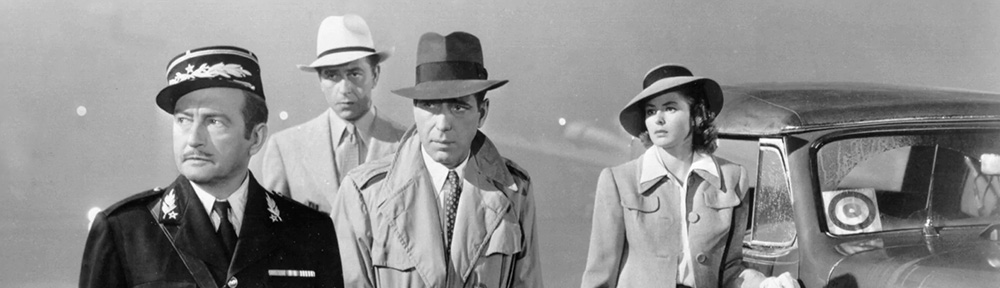
Casablanca was released in November of 1942, almost a year after the Japanese attack on Pearl Harbor brought an abrupt end to the political debate over whether America should intervene in the war. Yet that debate plays a central role in the movie, thematized in Bogart’s bitter declaration that he sticks his neck out for nobody.
That thematic focus can be traced to the screenplay’s origins as an unproduced stage play written in 1940, Everybody Comes to Rick’s. Warner Brothers purchased rights to the play in January 1942, shortly after the US declaration of war. Interestingly, the pair of screenwriters who adapted the play were around the same time working on series of seven propaganda films for the US Department of War titled Why We Fight.
Casablanca also provides us with the opportunity to dip a toe into a musical tradition very different from Beethoven, jazz. The movie features Dooley Wilson in the role of Sam, Rick’s loyal confidante who plays the piano in his saloon. Jazz is a distinctively American style of music; without Wilson’s presence at the piano, it’s hard to see how the place could properly be called “Rick’s Café Américain.” But jazz is also distinctively African-American, and Wilson’s relationship with Rick introduces American racial dynamics into a movie that is otherwise focused on what, if anything, America owes to the wider world.
Listening: Both of the following songs are classics, and date from the era of the movie. While both songs are upbeat, they also can be seen as offering sly commentary on race in America.
- Duke Ellington, “Take the A Train,” clip from 1943 movie Reveille: YouTube.
- Louis Armstrong, “Shine,” 1942 performance: YouTube.
Viewing: Michael Curtiz, Casablanca, available via BOB. (If this link doesn’t pull up the playlist, come back here and click on it a second time after you log in.)
Writing: Respond to ONE of the following prompts. Keep your response short, posting as a reply under the appropriate heading in the comments section:
- Call our attention to a moment in the movie that can be read as advocating for American intervention in WWII.
- Focusing on Rick’s relationship with Sam, what does Casablanca have to say about race? Call our attention to a particular moment and what it implies. (Feel free to reference the music of Louis Armstrong and/or Duke Ellington as well.)
- Focusing on the movie’s love triangle, what does Casablanca say about the role(s) of love and passion in society? Is love a force for order or for chaos?