
Category Archives: Assignment
Class 6.1
Critiques of Consumerism
Over the last 100 years, consumerism has risen to become perhaps the most widespread answer to the problem of alienation and anomie. Though family, nationality and religion remain powerful sources of identity, we define ourselves to a considerable extent by what we purchase: if not particular brands or products, then hobbies, songs, and shows we cherish. Our final class session focuses on two responses to consumerism: street art and a powerful short story by George Saunders.
Class Prep: the Politics and Aesthetics of Street Art
The Politics and Aesthetics of Street Art
Viewing:
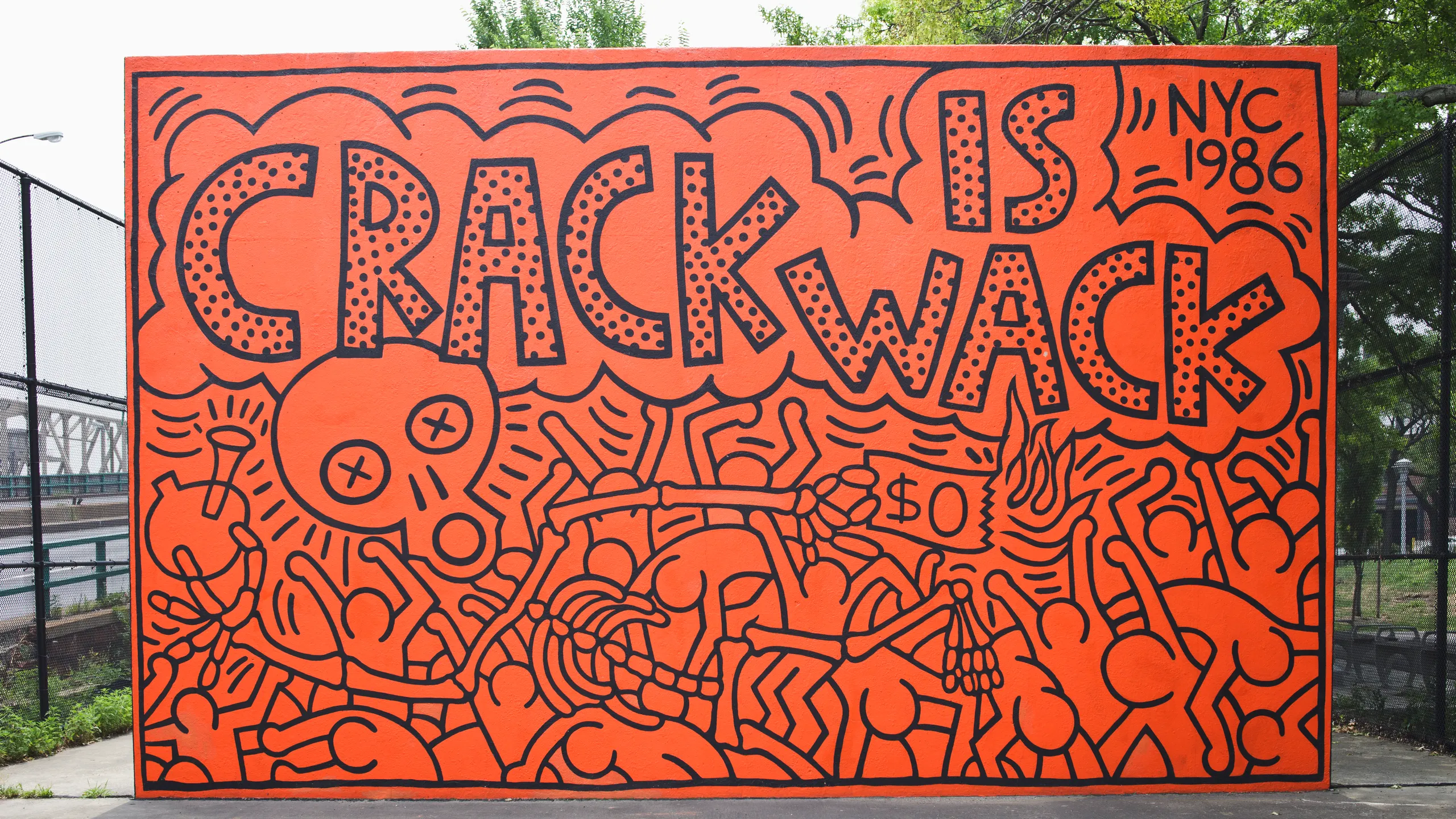
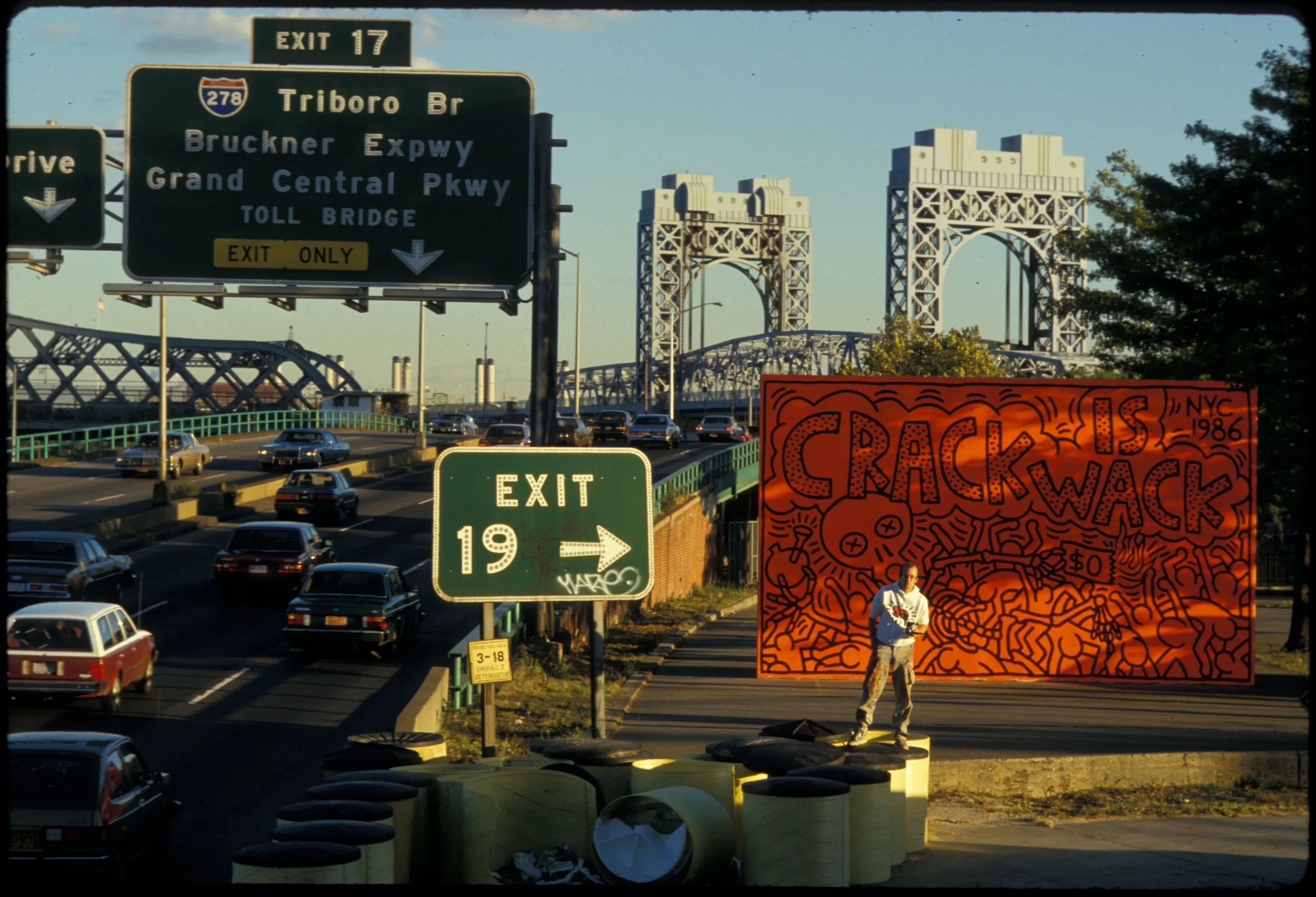


- Keith Haring, Crack is Wack (1986)
- Jean-Michel Basquiat, Melting Point of Ice (1984)
- Banksy, Parking (2010)
- Banksy, If Graffiti Changed Anything (2011)
Reading:
- Ana Bambic, “80’s Kings: Basquiat, Haring & Futura,” Widewalls Feb 13, 2014.
- “Banksy painting self destructs after $1.4 million sale,” CBS Evening News Oct 9, 2018.
Writing: Respond to ONE of the following prompts. Keep your response short, posting as a reply under the appropriate heading in the comments section:
- Point out a key contrast OR continuity in the street art featured above.
- Post a photo you took of street art here in London, then comment on how it draws upon or violates the tradition shown above.
Class Prep: Barbie and Consumerism
Purchasing Identity with Barbie and Ken
In 2024 I attended an exhibit on the history of the Barbie line of dolls and toys. It struck me as an instructive example of consumerism, for good and for bad.
Viewing:
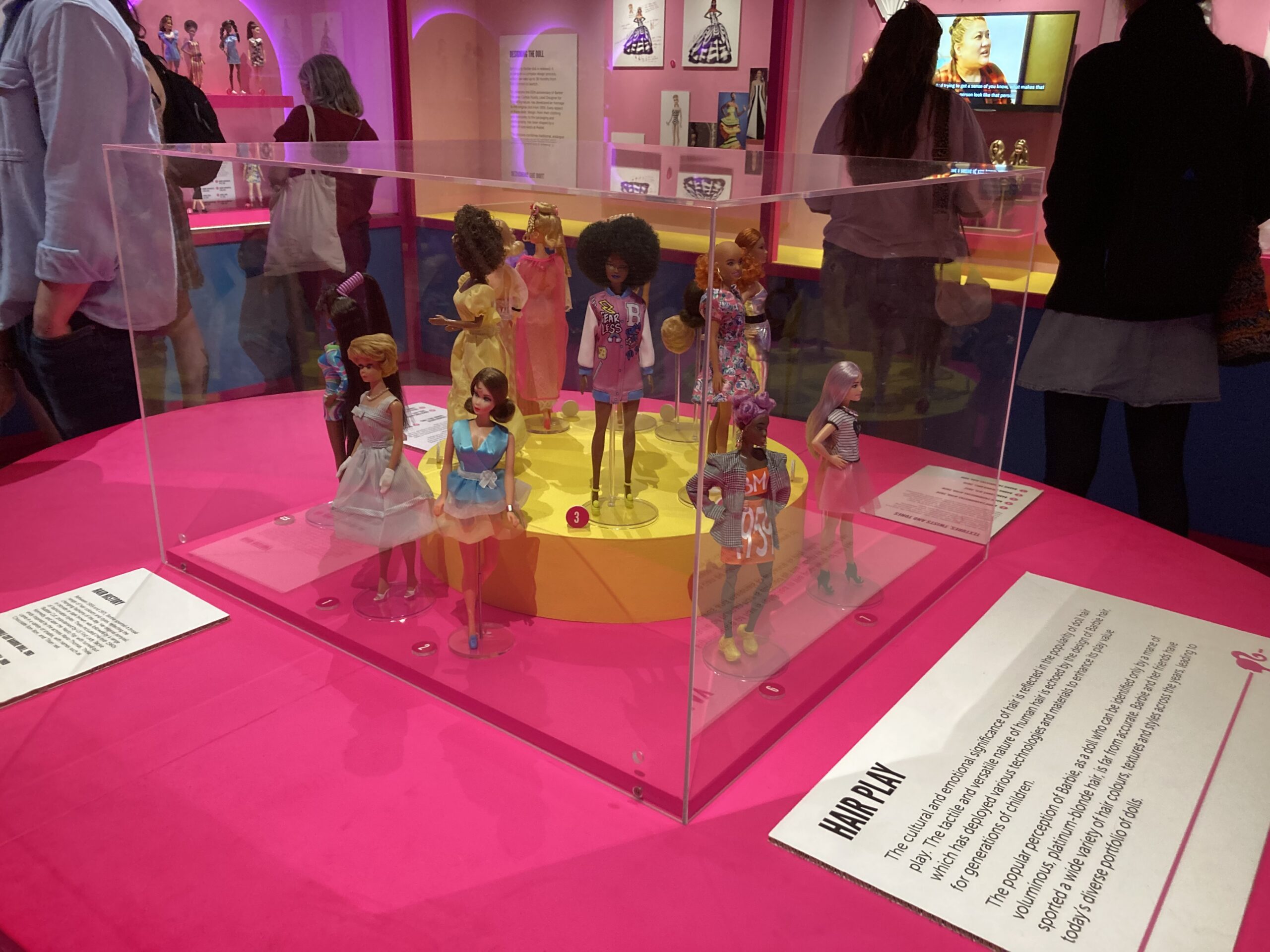
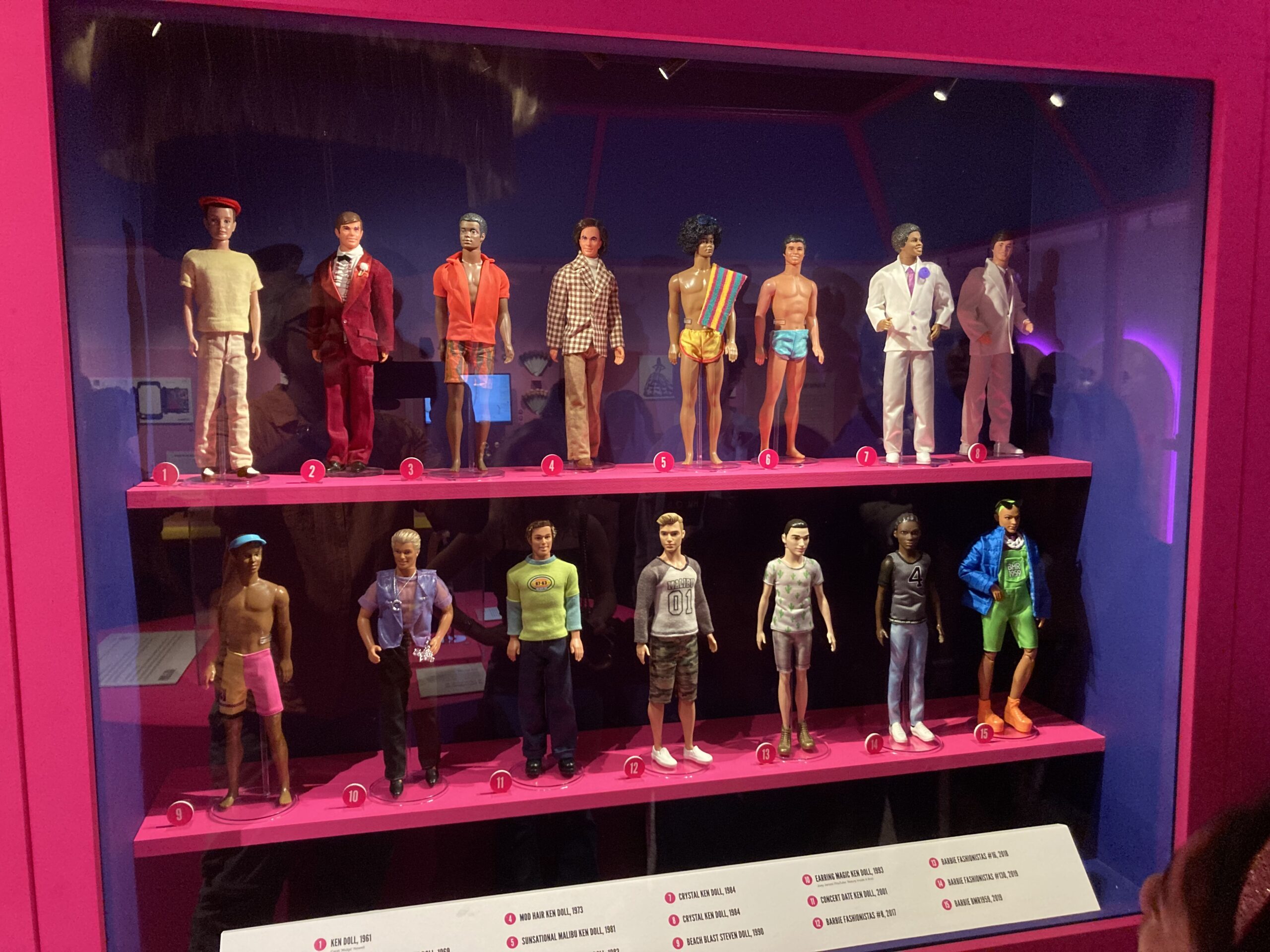
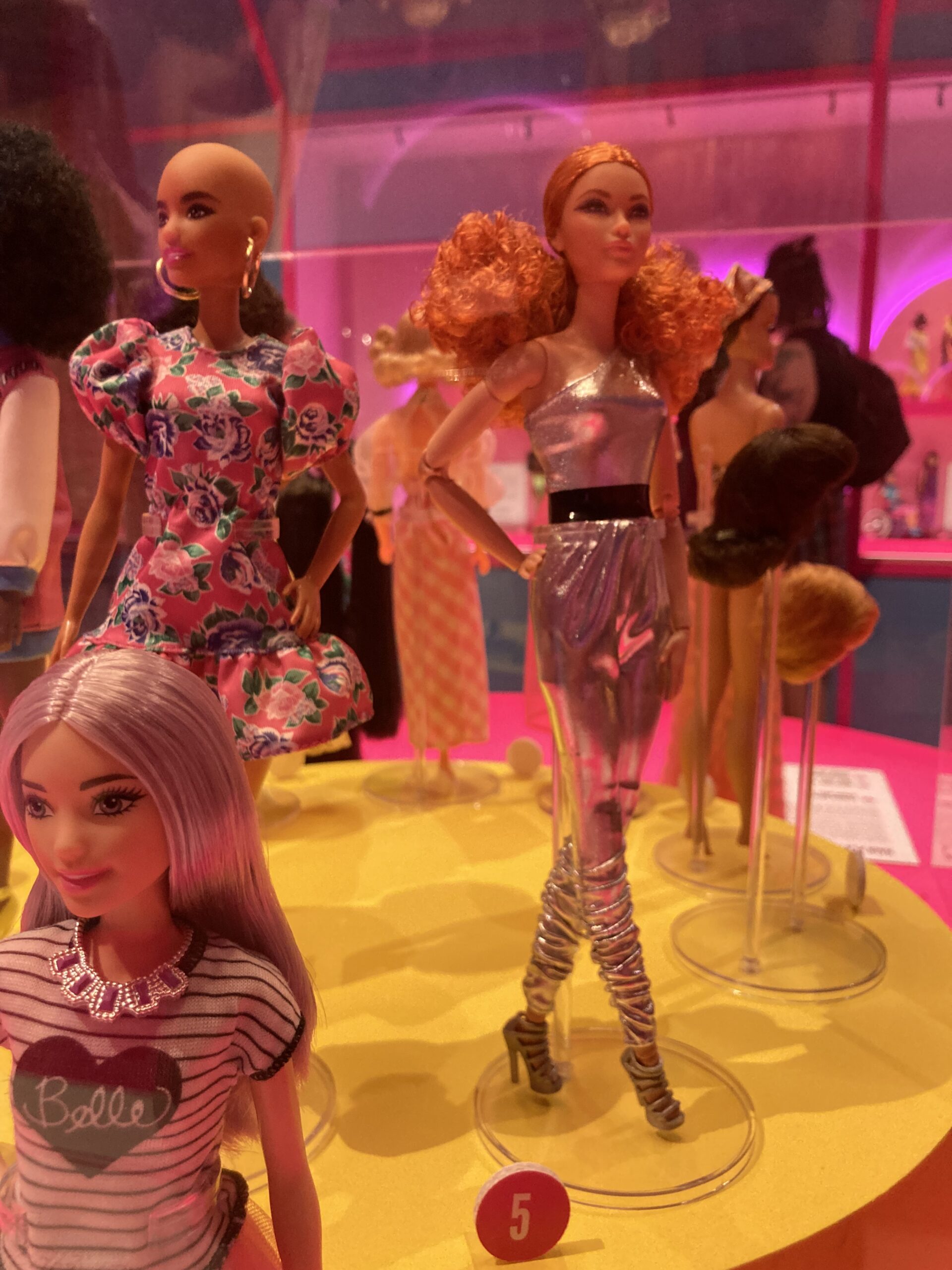
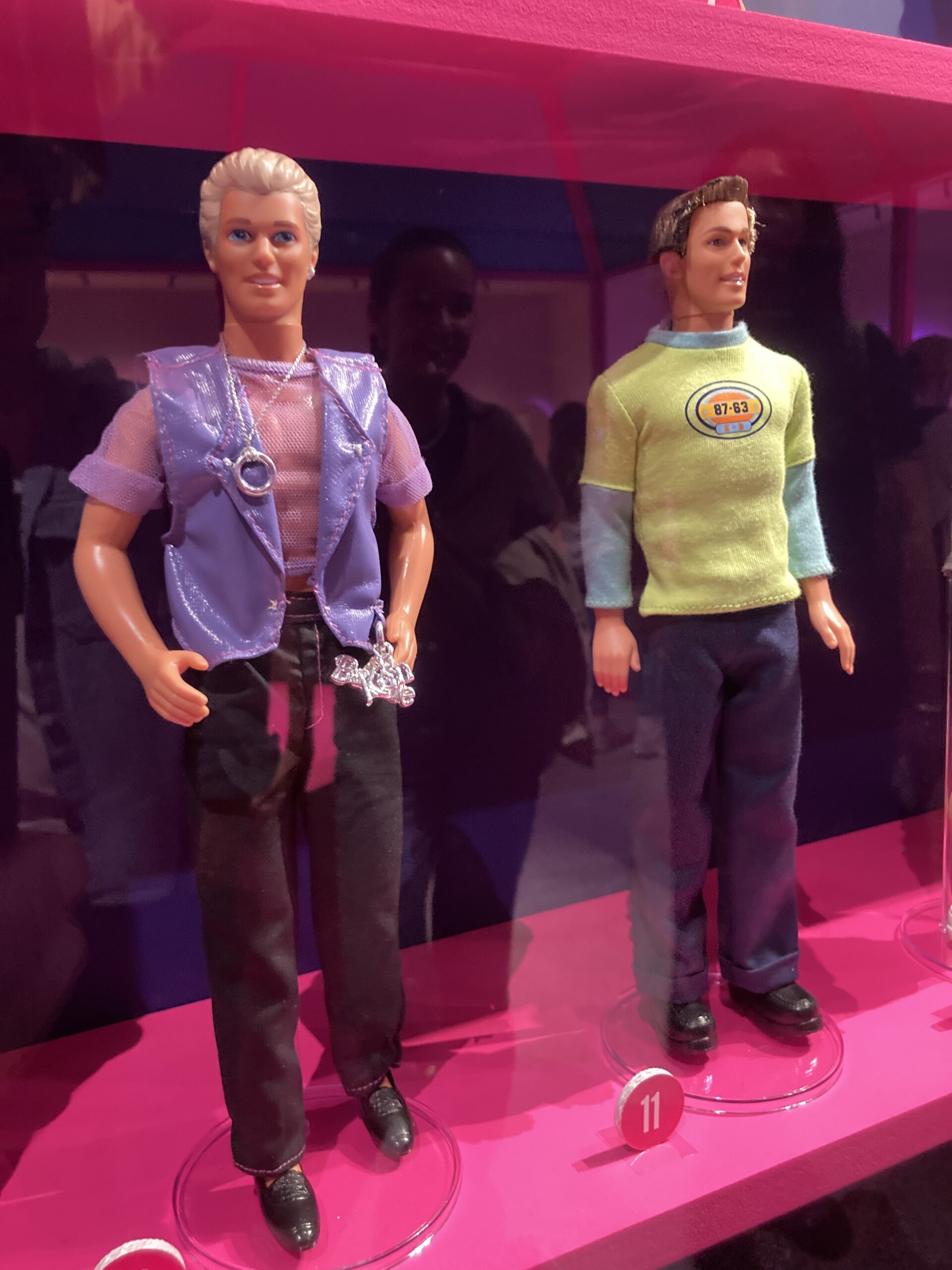

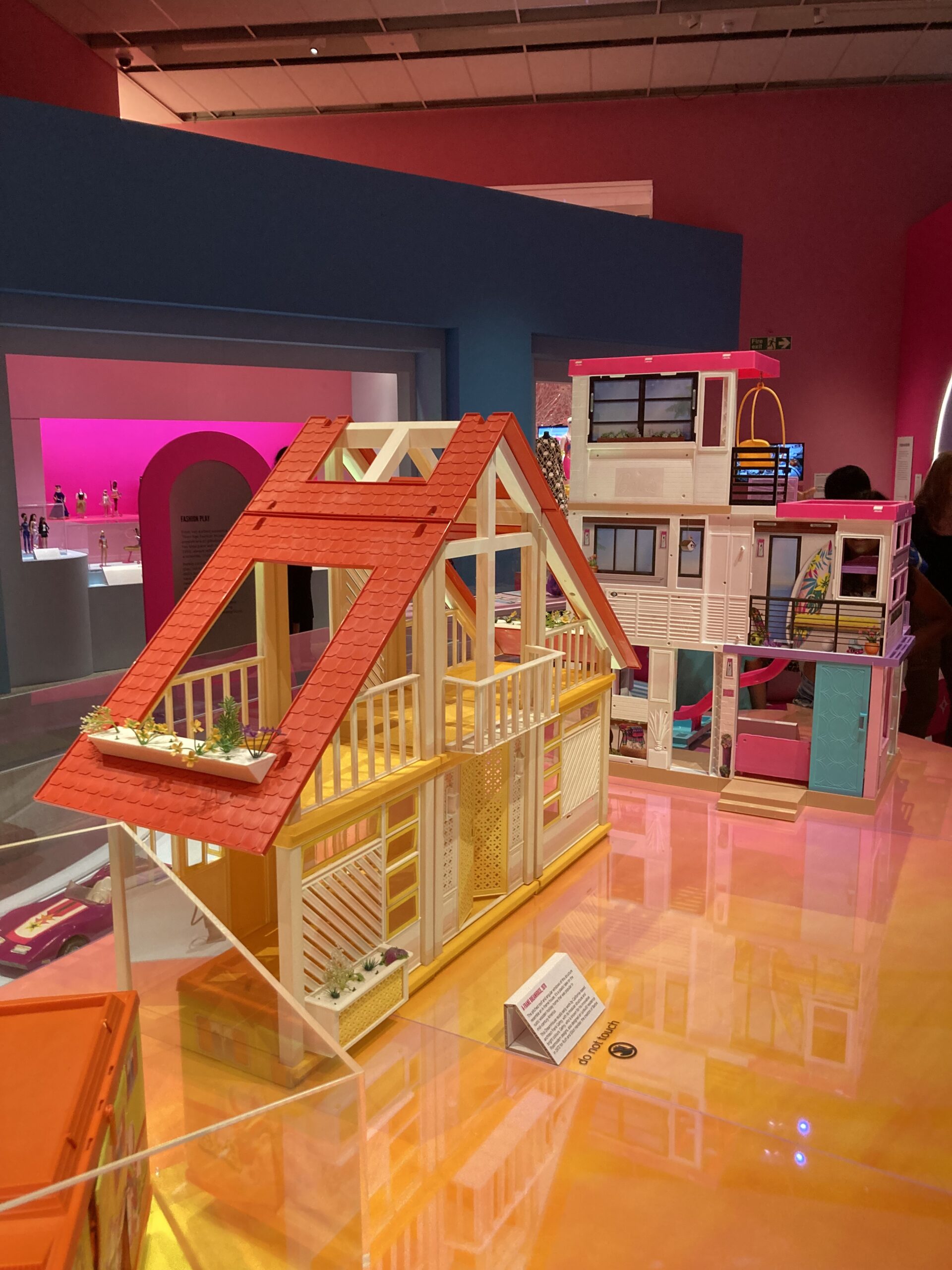
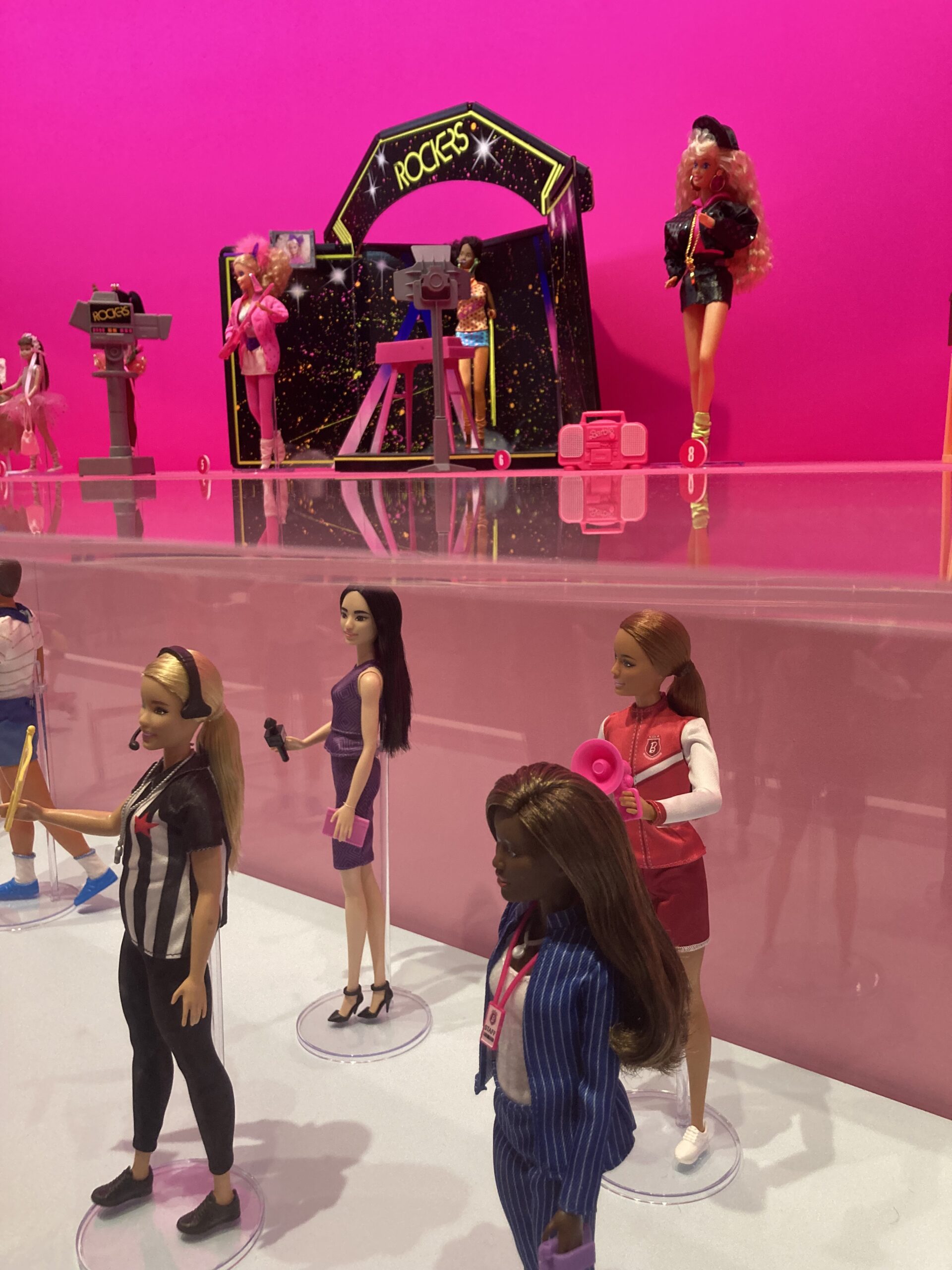
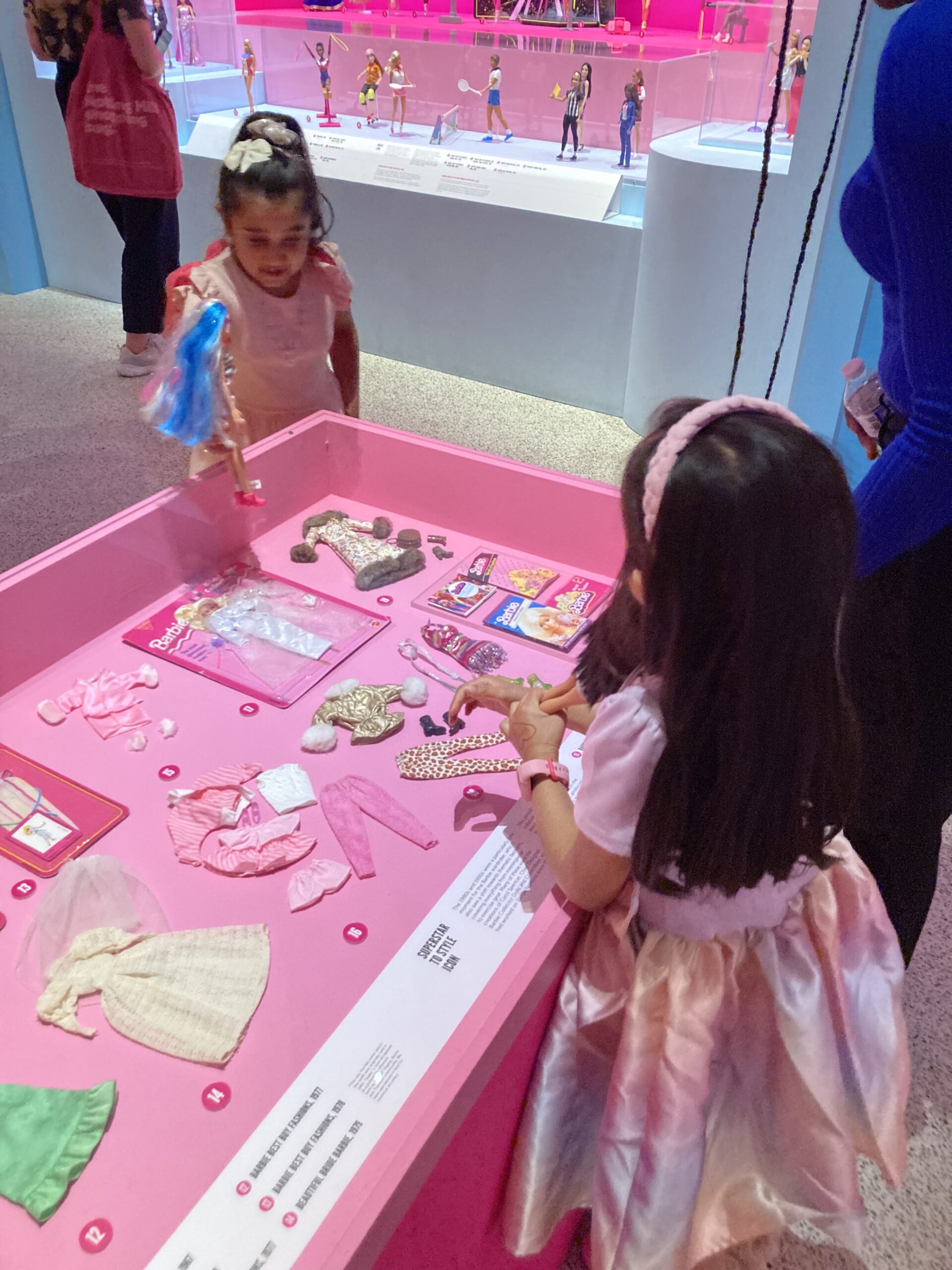
No HW, but come to class having thought a bit about how kids play with Barbie and similar toys. What fantasies do these toys embody? What ideology do they deploy?
Class 5.2
The Consensus Topples
Nowadays, we think of the American political divide in geographical terms. While geography played a part in the rift that opened up in the 1960s, back then they tended to think of it in terms of age: a generation gap between conformist adults and youthful activists. That gap found expression in sexual mores, in drug use, and in musical taste as well as in politics.
Class Prep: Beat Poetry
Beat Poetry
 Together with Jack Kerouac and William Burroughs, Alan Ginsberg was a founding member of the Beat Generation in the late 1950s. The Beats questioned the certitudes of consensus liberalism, highlighting the spiritual poverty of consumer culture. Many of the cultural trends we associate with the late 1960s, from free love to drug use, were initially explored by Beat writers and artists. Ten years later, Ginsberg served as an elder statesman to the Hippies of Haight-Ashbury in San Francisco during the Summer of Love (1968).
Reading:
- Alan Ginsberg, Howl (1956) (link). Note: you may find it valuable to listen to Ginsberg read his poem, in a 1959 recording: YouTube.
- Alan Ginsberg, “Footnote to Howl,” printed on the page immediately following: link.
Writing: Respond to ONE of the following prompts. Keep your response short, posting as a reply under the appropriate heading in the comments section:
- Quote and respond to a striking image or phrase from the poem.
- The poem opens with something like a howl. But what’s the emotional valence of this howl: rage? joy? something else? Explain your answer by quotation of a key line or phrase.
- How does the poem’s emotional valence shift in its later sections? In your answer, feel free to focus on any one of the later sections, including the “Footnote.” Explain your answer by quotation of a key line or phrase.
Class Prep: Art and Activism
Artistic Transformation and Political Activism
Viewing: Corita Kent:


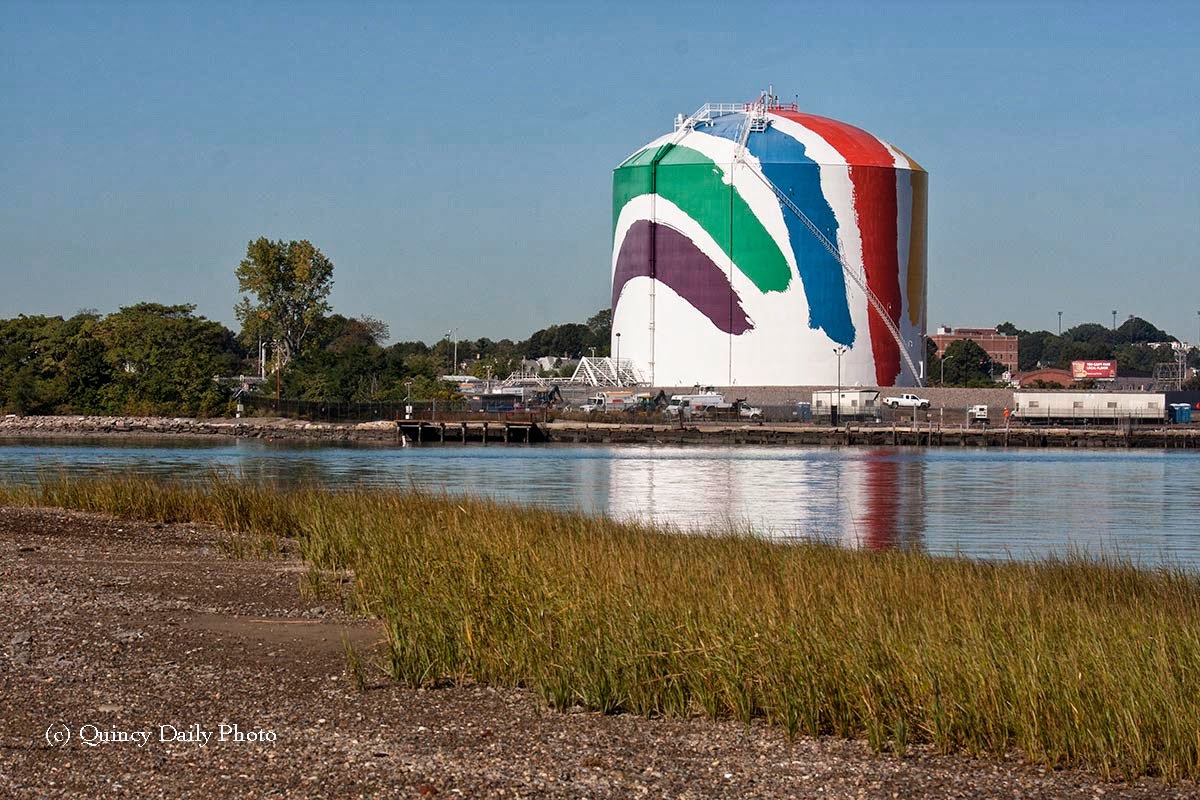

- Corita Kent, that they may have life (1964)
- Corita Kent, Rainbow Swash (1971)
- Corita Kent, Love stamp (1985)
Viewing: Jasper Johns, Flag Paintings:

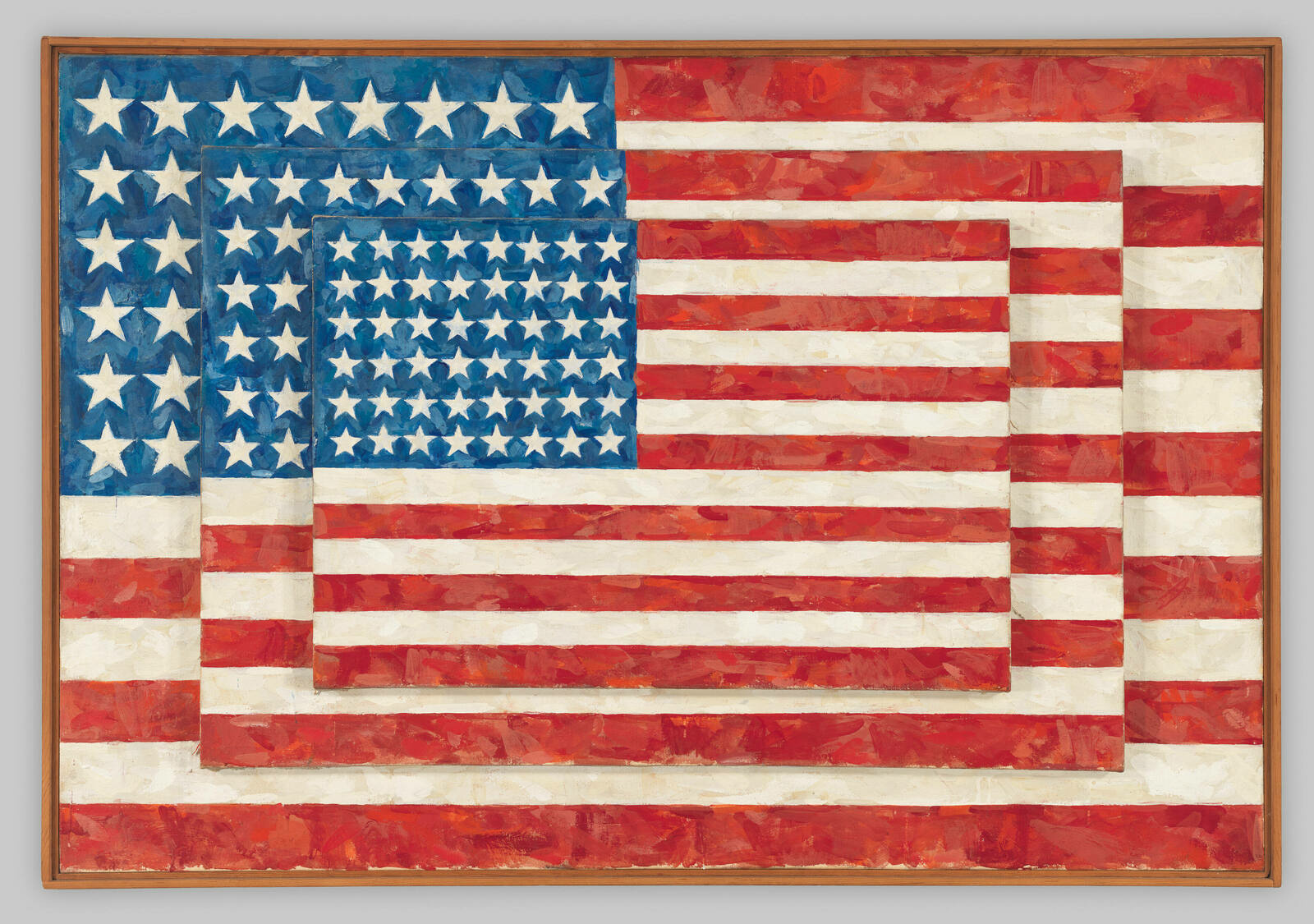

- Jasper Johns, Flag (1954)
- Jasper Johns, Threee Flags (1958)
- Jasper Johns, Flag Moratorium (1969)
Viewing: Jimi Hendrix, “Star Spangled Banner” (leads into “Purple Haze”) performed at Woodstock, Aug 1969.
Writing: Respond to ONE of the following prompts. Keep your response short, posting as a reply under the appropriate heading in the comments section:
- Many of these artworks rework preexisting culture. Focusing on one in particular, give a rich description of what it adds, subtracts, or otherwise does to transform the original.
- Identify one of these pieces that strikes you as turning non-art into art. What’s at stake, culturally, in this act of transformation?
- Identify one of these pieces that strikes you as voicing a political message. What’s the message, and how is it being voiced?
Class 5.1
The Postwar Liberal Consensus
We live today in a nation riven nearly in two by a deep cultural and political divide. So it’s hard to imagine that the 1950s and early 60s were characterized by the opposite state of affairs. “It was an age of consensus,” writes Geoffrey Hodgson in his seminal 1976 history, America In Our Time. That consensus was ideologically liberal in the sense of believing in freedom and the future, but conservative in its complacent insistence that America had the rest of the world beat when it came to just about everything. The ideology of the liberal consensus drew in part upon the strength of the American economy in the wake of WWII. And it relied upon a willful blindness to the treatment of women and minorities.
Today we’re looking at a range of artifacts that reflect that era of consensus, even as some of them work to push the envelope. And in the next class we’ll see how the consensus foundered in the final years of the 1960s, overtaken by youthful activists who called for a more thoroughgoing rethinking of America, from antiwar activists to Black Panthers to Women’s Libbers to the Stonewall rioters.
Class Prep: Postwar American Art
Art in America After the War
New York became the art capital of the world after World War II. In the run-up to the war, artists of the avant-garde fled Europe for the safety of America. But the shift also reflected America’s rise in the world, not to mention the confidence of its often experimental artists.
Abstract Expressionism
Reading: Strickland, pp 158-161, 166.
Reading: Alastair Sooke, “Was modern art a weapon of the CIA?” BBC.com, Oct 4, 2016.
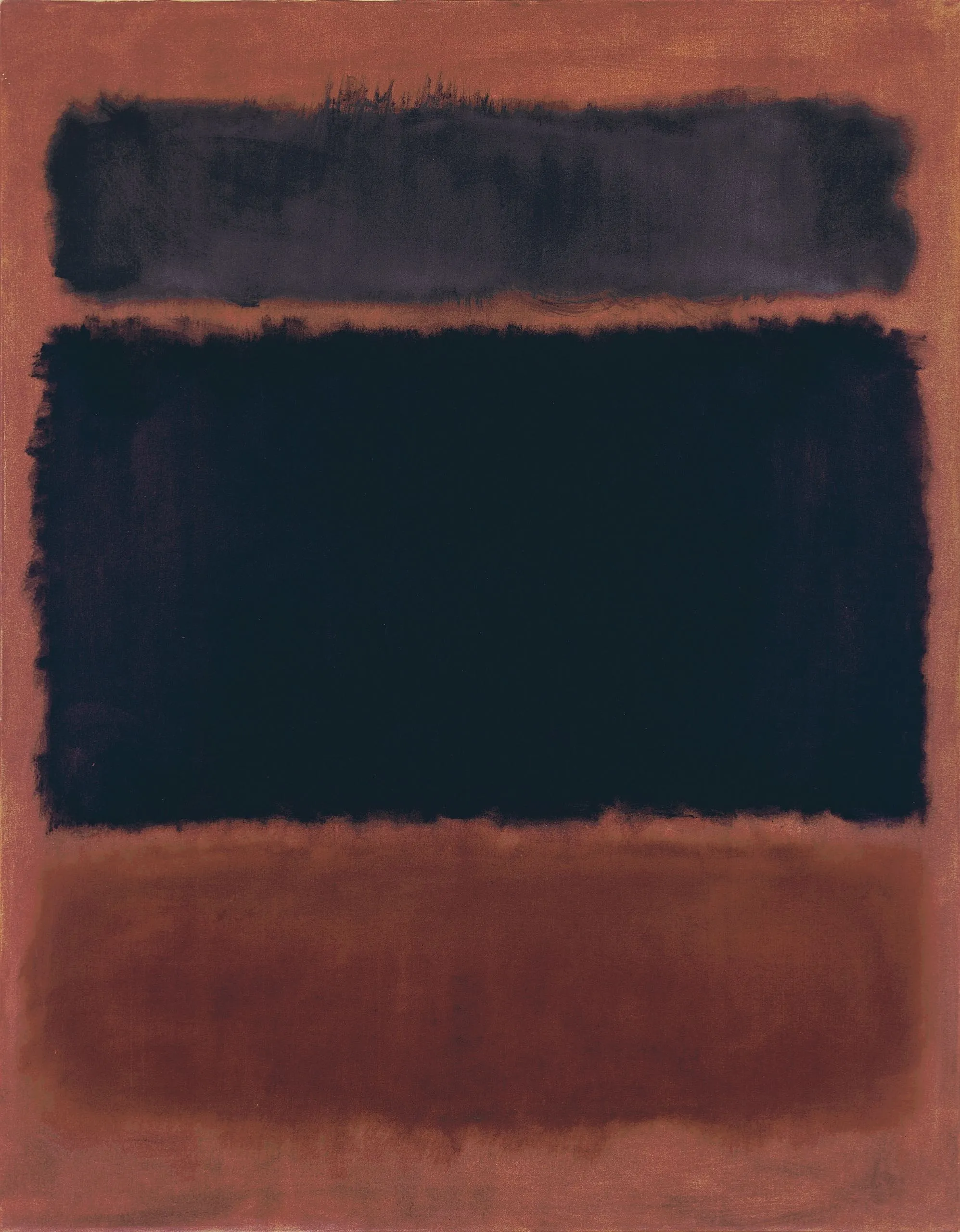
Viewing: examples of Abstract Expressionism:



- Willem de Kooning, Woman/Verso: Untitled (1948)
- Jackson Pollock, One: Number 31 (1950) (check out this brief MOMA video)
- Mark Rothko, Black in Deep Red (1957)
- Clyfford Still, PH-971 (1957)
In Class: we also discussed Willem de Kooning’s Excavation, which I’m adding here:

Excavation, painted on a 6-foot-by-8-foot canvas, was de Kooning’s largest painting through 1950.
Pop Art
Reading: Strickland, pp 172-176.
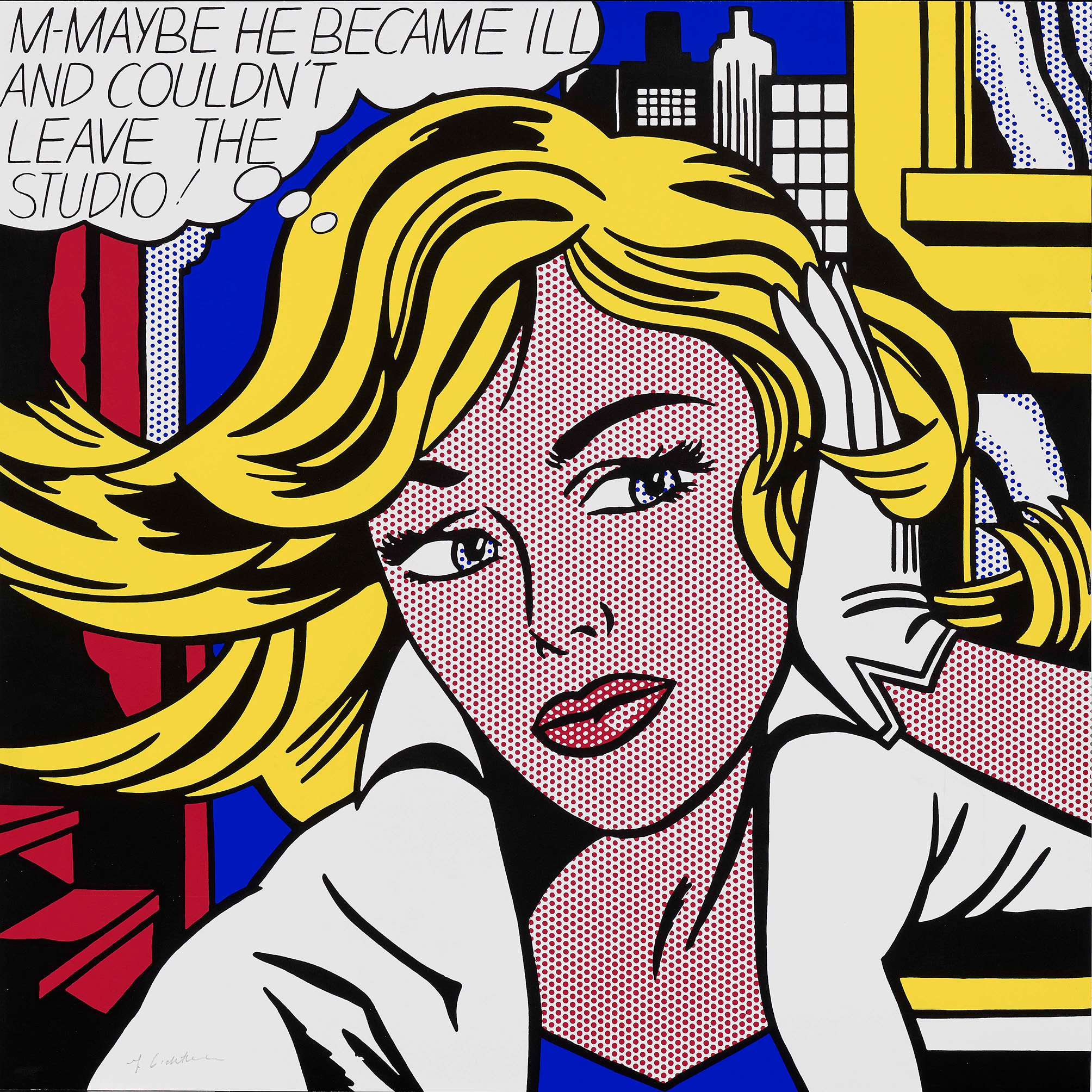
Reading: Ben Panko, “The Comic Artists Who Inspired Roy Lichtenstein Aren’t Too Thrilled About It,” Smithsonian Magazine, October 27, 2017.
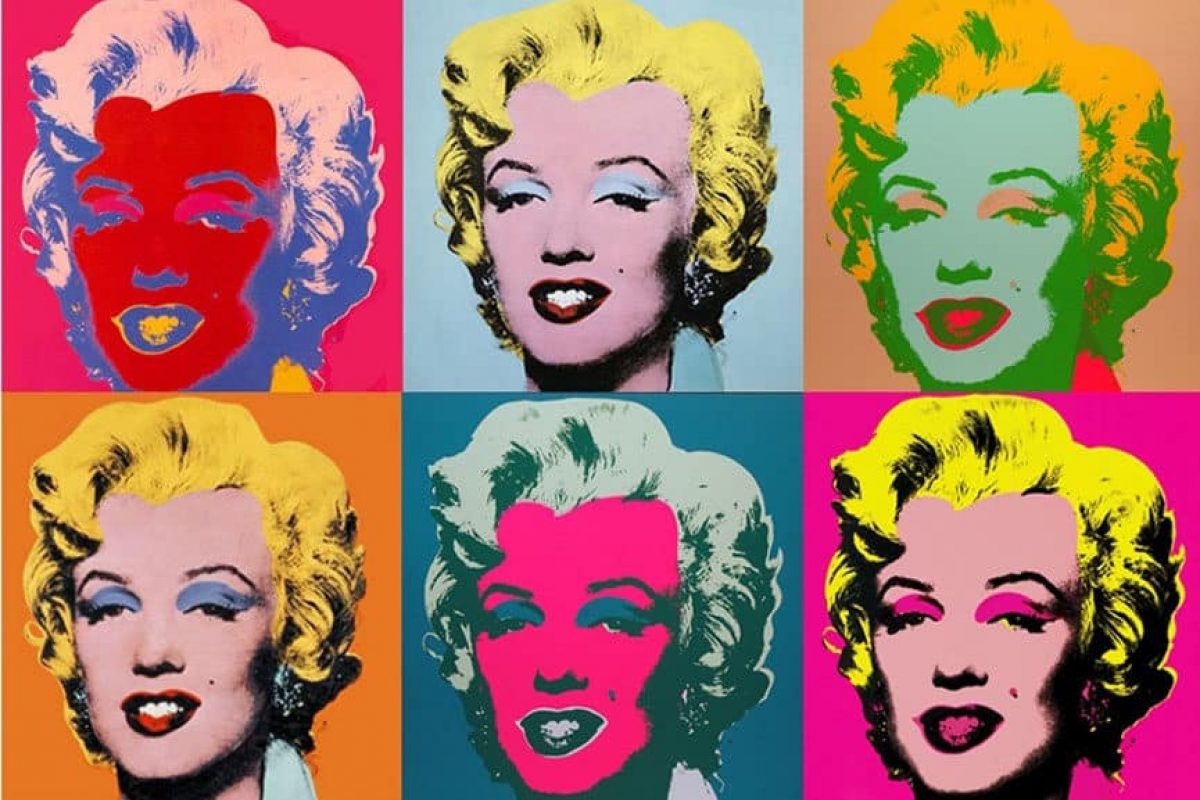
Viewing: examples of Pop Art:


- Jasper Johns, Target with Four Faces (1955)
- Roy Lichtenstein, M-Maybe (1965)
- Andy Warhol, Marilyn (1967)
- Claes Oldenburg, Clothespin (1976)
Writing: Respond to ONE of the following prompts. Keep your response short, posting as a reply under the appropriate heading in the comments section:
- Point out a key contrast OR continuity in the art featured above.
- Choose an artwork from today’s assignment that you find particularly engaging. Look at it for 3 minutes, then briefly describe your experience, pointing to particular details or visual qualities that helped produce that experience.
Class Prep: A Tale of Two Panthers
The First Black Superhero
 The Black Panther made his debut on the cover of the July 1966 issue of Fantastic Four: an agile, black-garbed human figure springing triumphantly above the titular characters, who were busy exploring a strange and tangled jungle of circuitry. In a curious historical coincidence, Stan Lee and Jack Kirby invented the character around the same moment as activists working to get out the Black vote in Lowndes County, Alabama, adopted a black panther as their logo. A few months later, in October 1966, that logo inspired the formation of the Black Panther Party for Self-Defense in Oakland, California.
While Marvel’s Black Panther proved popular with readers, his fame was soon eclipsed by the Party, when Black Panthers entered the California State Capitol, fully armed, to protest a proposed change in gun regulations. They made it as far as the floor of the Assembly chamber before being disarmed and escorted from the building.  Party members would later claim that the group did not intend to commandeer the legislative process that day, but merely took a wrong turn on their way to the visitors gallery. Blunder or not, the optics of an armed coup were irresistible to the news media: “Capitol Is Invaded,” ran the full-width banner headline on the Sacramento Bee’s front page. Keep this context in mind as you read the two-issue story that introduced Marvel’s Black Panther.
Reading: Stan Lee and Jack Kirby, “The Black Panther” and “The Way It Began,” Fantastic Four #52 & #53.
Writing: Respond to ONE of the following prompts. Keep your response short, posting as a reply under the appropriate heading in the comments section:
- Can this comic-book hero be seen as an exponent of “Black Power”? Focus our attention on a particular image or plot event as evidence.
- Does this comic book confirm colonialist stereotypes about Africa? Or does it problematize them? Focus our attention on a particular image or plot event as evidence.
Class 4.2
The Case for Fighting Hitler
In retrospect, it’s hard to believe that there ever was a time when Americans weren’t eager to join the war against Hitler. Nowadays Nazis are the go-to enemy in movies and videogames, and WWII is regarded (by contrast to Vietnam, Afghanistan and Iraq) as the “Good War.” But Isolationism was a powerful political force in the 1930s and early 40s, campaigning under the banner of “America First!”
The following comics and movies all have a strong political bent. Does this make them propaganda, despite not being created under government sponsorship? If they are propaganda, does that make them bad art?
Class 4.1
Surrealism and Alienation
Class Prep: Surrealism
Surrealism
Surrealism seeks to draw upon the imaginative power of the unconscious mind to challenge received ways of thought and so bring about a revolutionary consciousness. I use the present tense in this sentence because while Surrealism first blossomed in 1920s Paris, the movement still has practitioners working in the present day. It first emerged as an outgrowth from Dada. Artists working under the banner of Dada had sought to tear down meaning, but as Surrealists they came to embrace a communitarian ethos—and they engaged in a long running dalliance with the French Communist Party. In the “Manifesto of Surrealism” (1924), Andre Breton theorized imagination, in opposition to the straitjacket of pragmatic utilitarianism, as opening a path to freedom, the first step in reinventing the world order:
Beloved imagination, what I most like in you is your unsparing quality. The mere word “freedom” is the only one that still excites me. I deem it capable of indefinitely sustaining the old human fanaticism. It doubtless satisfies my only legitimate aspiration. Among all the many misfortunes to which we are heir, it is only fair to admit that we are allowed the greatest degree of freedom of thought. It is up to us not to misuse it. To reduce the imagination to a state of slavery—even though it would mean the elimination of what is commonly called happiness—is to betray all sense of absolute justice within oneself. Imagination alone offers me some intimation of what can be, and this is enough to remove to some slight degree the terrible injunction; enough, too, to allow me to devote myself to it without fear of making a mistake (as though it were possible to make a bigger mistake).
Reading: Strickland, pp 148-51.
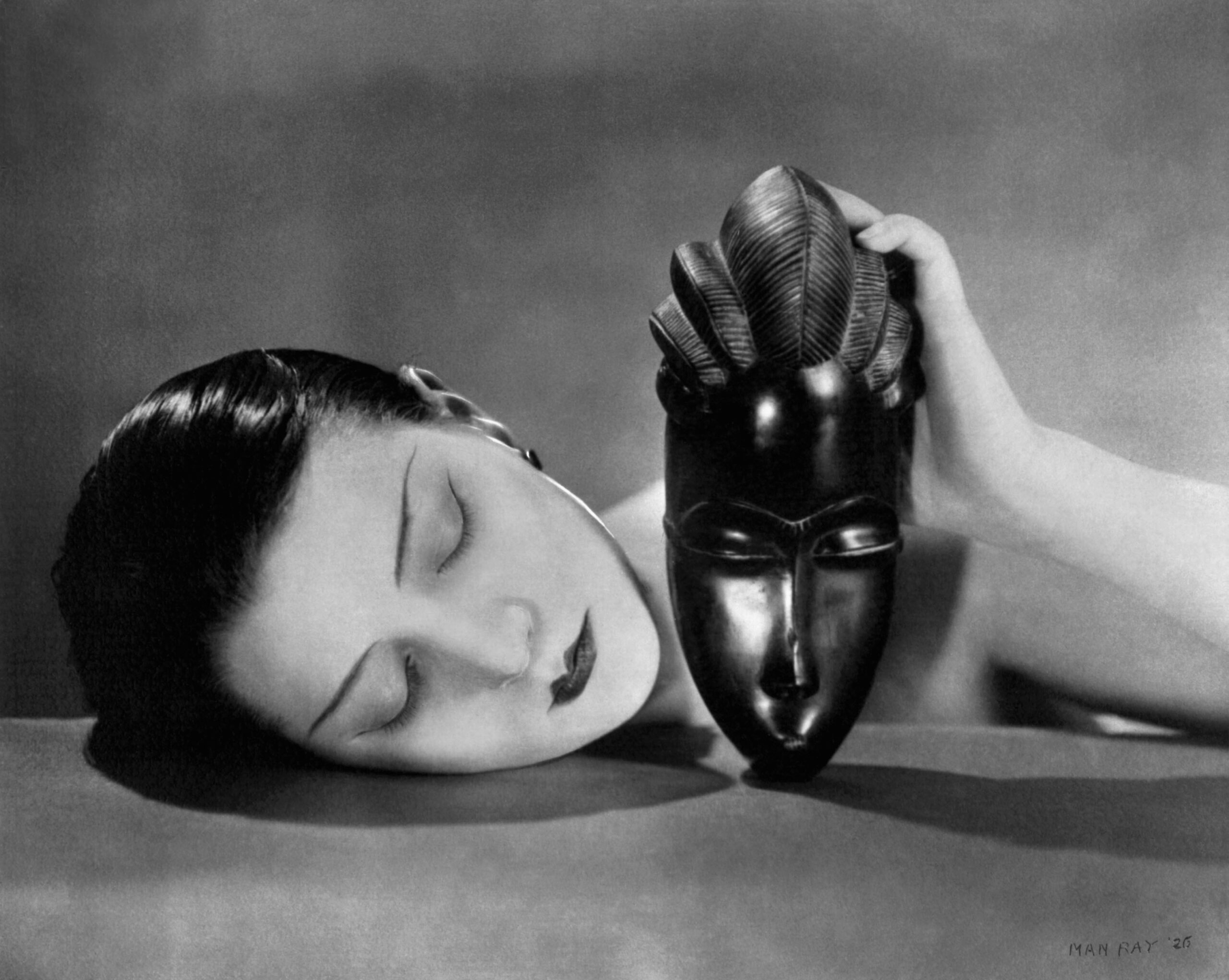
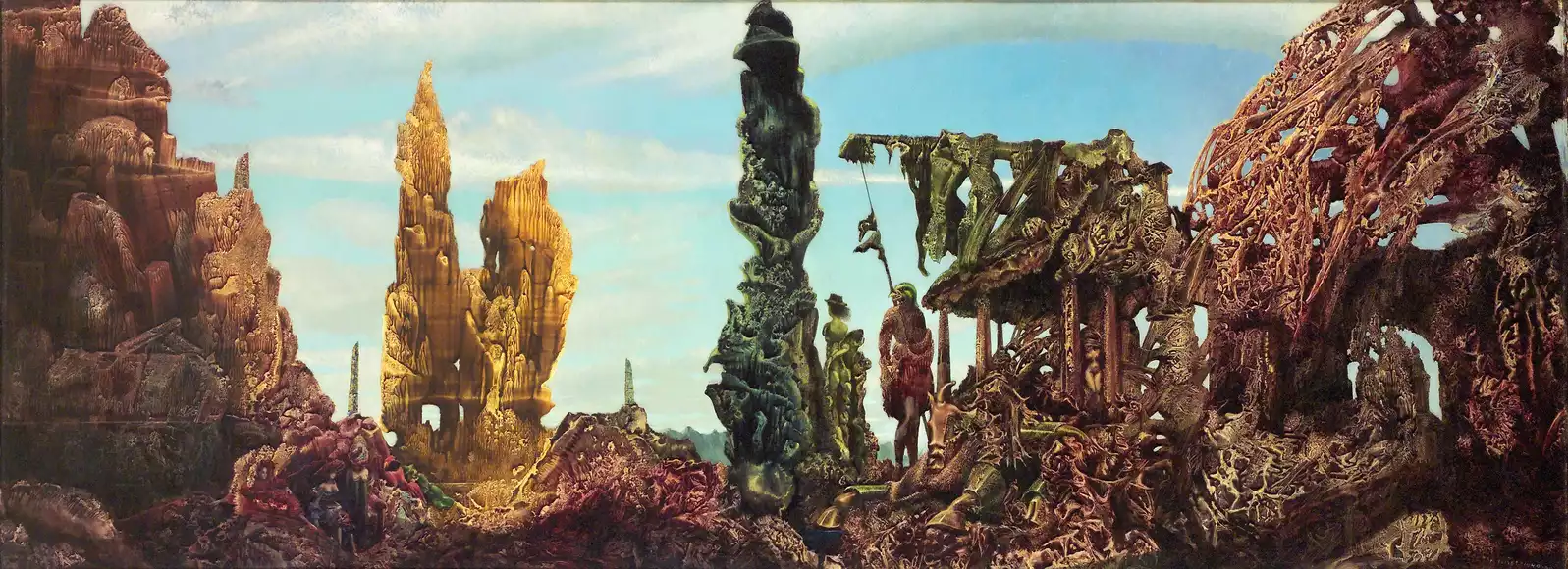
Viewing: Surrealist art




- René Magritte, The Double Secret (1927)
- René Magritte, The Treachery of Images (1929)
- Man Ray, Black and White (1926)
- Man Ray, Sleeping Woman (1929)
- Salvador Dali, The Persistence of Memory (1931)
- Méret Oppenheim, Object (1936)
- Elsa Schiaparelli and Salvador Dali, Lip Dress and Shoe Hat (1937)
- Max Ernst, Europe After the Rain (1942)
Writing: Respond to ONE of the following prompts. Keep your response short, posting as a reply under the appropriate heading in the comments section:
- Point to a stylistic or thematic pattern you see in some or all of these artworks.
- Point to a striking detail in one particular artwork.
- How does Surrealism compare to Expressionism? Point to a similarity or contrast between specific works.
Class 3.2
Expressionism and Alienation
 In Social Science you’ve learned about Emile Durkheim’s theory of anomie: a breakdown of social norms precipitated by the shift from small rural communities to large-scale urban life. In the first half of the twentieth century, many writers and visual artists gave voice to a sense of alienation, none more famously than Edward Munch in The Scream (1910).
Both Eliot’s Waste Land and Chaplin’s Modern Times channel the theme of alienation. For class today we examine artists who raised this anxiety to a fever pitch: the Expressionists.
Class Prep: Expressionism
Expressionism
Expressionism in art is often traced to the influence of Edvard Munch, whose Scream captures the artist’s tortured soul. In the years before the War, Expressionism spread from painting to poetry, drama and film and after the war it came to define the Avant-Garde in Weimar Germany.
Reading: Strickland, pp 123, 142-44.
Viewing: Expressionist art


- Edvard Munch, The Scream (earliest version 1893; this version 1910)
- Egon Schiele, Self-Portrait (1910)
- Otto Dix, Storm Troopers Advance under a Gas Attack (1924)
- Otto Dix, Portrait of the Journalist Sylvia von Harden (1926)
- Max Beckmann, Self-Portrait with Champagne Glass (1919)
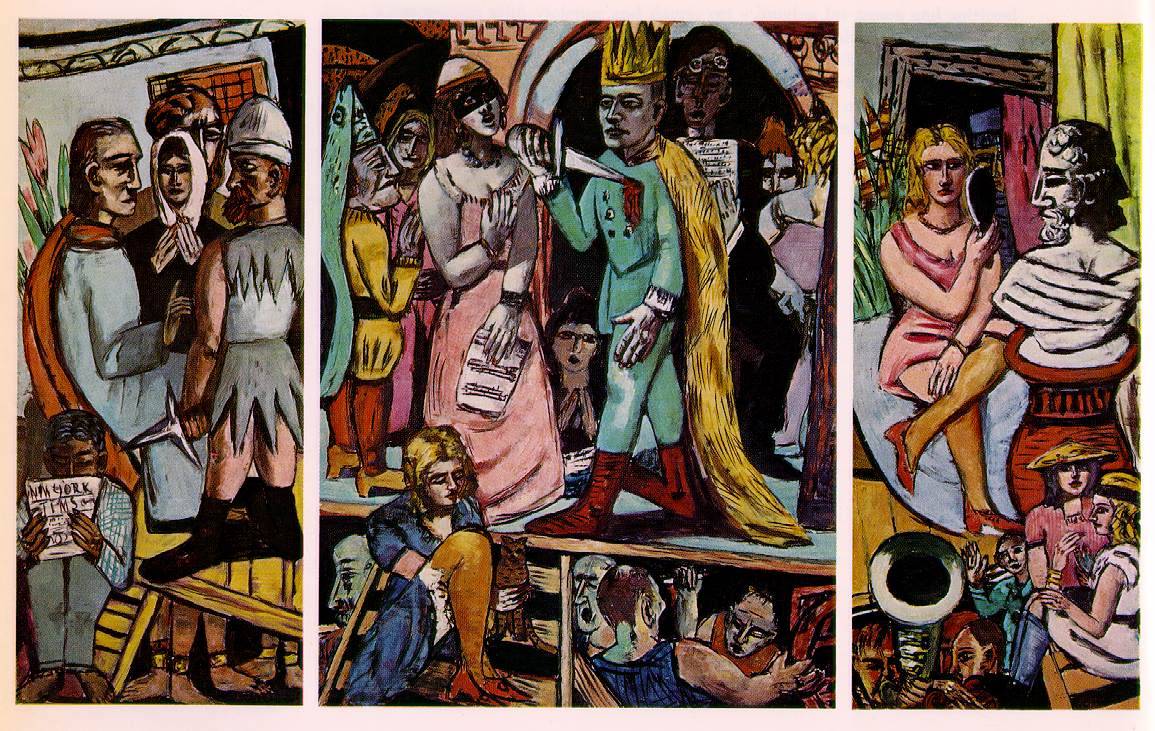
- Max Beckmann, The Actors (1942)
Writing: Respond to ONE of the following prompts. Keep your response short, posting as a reply under the appropriate heading in the comments section:
- Point to a stylistic or thematic pattern you see in some or all of these artworks.
- Point to a striking detail in one particular artwork.
- Given that “anomie” is defined as the loss of social norms, point to a particular artwork and explain how it challenges or violates the viewer’s normative expectations.
Class 3.1
Collage and the Crisis of Meaning
The turn of the century in 1900 spurred futuristic dreams, but few anticipated the century brought into being fourteen years later by World War I. A generation of of young men lost their lives, apparently to no purpose. The ruling class lost its legitimacy, resulting in significant changes in Britain—and a revolutionary changes in Russia, Austria, Turkey, and Germany. The system of international trade collapsed, replaced by protectionism and isolationism. More fundamentally, the war’s brutality challenged a deep-set faith that technological and social progress would march ever forward in lockstep. In the wake of the conflict, Democracy seemed outdated, a relic of the Enlightenment; the new world called for a new mass politics, whether in the mode of Communism or Fascism.
Class Prep: Cubist Collage
Collage and the Modern Age
Both scholars listed below agree on the centrality of collage to modernist art; they disagree only in how broadly they define Modernism. Greenberg focuses wholly on developments within the field of painting, while Hopkins speaks of culture in the broadest sense: literature, film, etc.
Scholarly Reading: Two Perspectives on Collage
- Clement Greenberg, “The Pasted-Paper Revolution” (1958) (Blackboard)
- Budd Hopkins, “Modernism and the Collage Aesthetic” (1997) (Blackboard)
Viewing: Analytic and Synthetic Cubism


- Pablo Picasso, Les Demoiselles d’Avignon (1907)
- Georges Braque, Violin and Palette (1909)
- Pablo Picasso, Still Life with Chair Caning (1911)
- Georges Braque, Homage to J. S. Bach (1911-12)
- Pablo Picasso, Guitar, Sheet Music and Wine Glass (1912)
- Juan Gris, The Table (1914)
Writing: Respond to ONE of the following prompts. Keep your response short, posting as a reply under the appropriate heading in the comments section:
- Point to ONE quality that these Cubist works share in common with the Futurist art we examined last week. Alternatively, point to something that makes them distinct.
- Drawing on Greenberg or Hopkins—or just pointing to the art itself, should Cubist collage be classed as mimetic or expressive art? Or some third thing?
Class 2.2
Man and the Machine Age
As the nineteenth century came to a close, the world teetered on the brink of a global shift of consciousness, one so significant that it usurped the word “modern” to mean “the culture of the 1920s” rather than “the culture of the present day.” We begin our multi-session exploration of the Modern Age by looking at the role that machines played in this transformation.
Class Prep: Futurism
Loving the Machine
In the years leading up to World War I, a group of Italian artists came together under the banner of Futurism. Whereas Art Nouveau sought compromise with modernity, reshaping metal and glass in soft organic curves, the futurists welcomed the hard edges and high speeds of machinery.
 When conflict broke out in 1914, it was greeted with enthusiasm across Europe, but for most that excitement gave way to horror as reports filtered back from the front lines of the meat grinder of trench warfare. Paradoxically, the era’s powerful technologies—machine guns, artillery shells—produced stalemate rather than speedy victory. But while this experience left many determined to make the “Great War” the “War to End All Wars,” the Futurists remained enamored of both machinery and armed conflict, believing that violence could reenergize Italy. Unsurprisingly, in the years after the war’s end in 1918, they allied themselves with the National Fascist Party of Benito Mussolini.
Reading: “The Futurist Manifesto,” published in 1909 by Filippo Marinetti on the front page of the Parisian daily Le Figaro (Blackboard).
Viewing: examples of Futurist art:
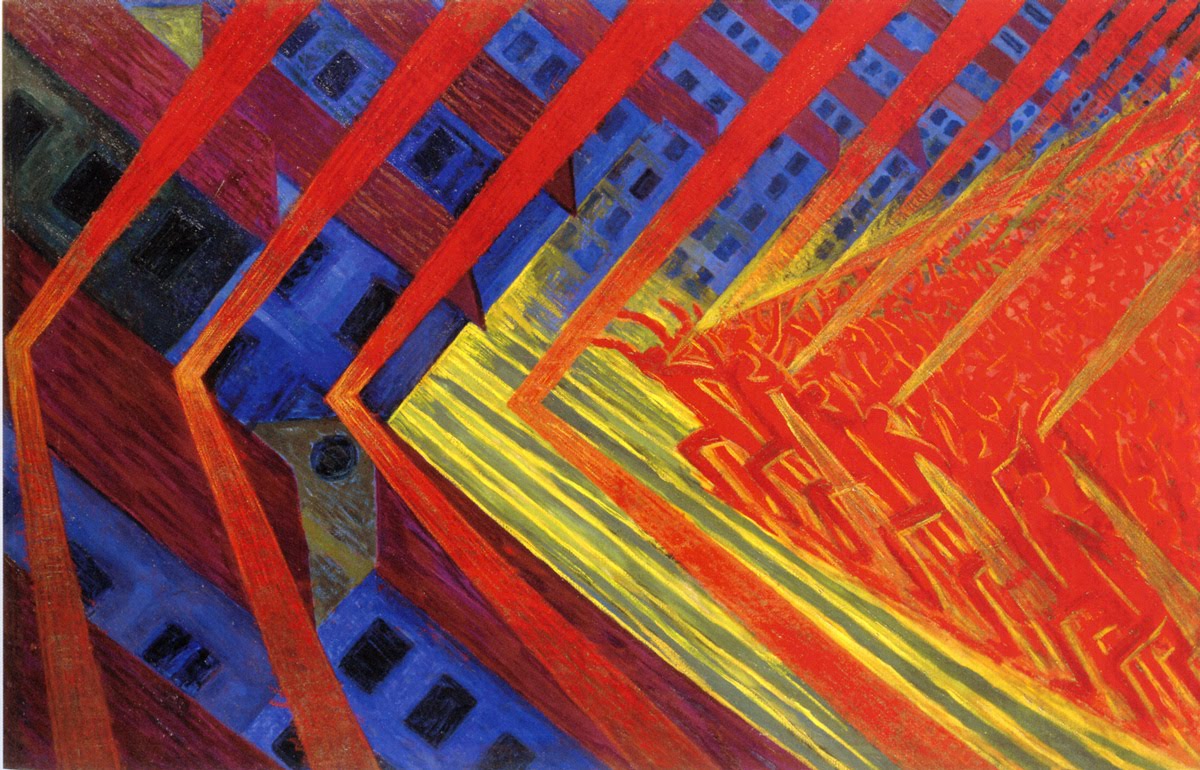


- Luigi Russolo, The Revolt (1911)
- Luigi Russolo, Dynamism of an Car (1913)
- Umberto Boccioni, Unique Forms of Continuity in Space (1913)
- Gino Severini, Memories of a Journey (1911)
- Gino Severini, Armored Train in Action (1915)
- Filippo Marinetti, In the Evening, Lying on Her Bed, She Reread the Letter from Her Artilleryman at the Front (1919)
Writing: Respond to ONE of the following prompts. Keep your response short, posting as a reply under the appropriate heading in the comments section:
- Point out a key contrast OR continuity in the Futurist art featured above.
- Point out a key contrast OR continuity between Marinetti’s 1909 manifesto and one of the Futurist artworks.
In Class: Duchamp's Nude Descending a Staircase
Photography and Motion
English photographer Eadweard Muybridge began his pioneering work into the study of motion in 1878. Using multiple cameras with high-speed film, Muybridge established for the first time the stride of a galloping horse, as well as a host of other motions too fast for the eye to follow. He changed the way we see the world. And, by breaking motion down into a series of static frames, his work beckoned the way to re-animation of static sequences as movies.
Around the same time, French photographer Étienne-Jules Marey perfected a method for superimposing multiple moments on a single photograph, as for example the image of a pelican landing.
Both photographers’ influence can be seen in one of the most famous works of Modernist Art, Marcel Duchamp’s Nude Descending a Staircase, as well as Futurist works like Giacomo Balla’s 1912 Dynamism of a Dog on a Leash.


- Muybridge, Horse’s Gallop (1878)
- Marey, Pelican landing (1882)
- Duchamp, Nude Descending a Staircase (1912)
- Balla, Dynamism of a Dog on a Leash (1912)
Class 2.1
Contrasting Visions of Nature
Special Class Trip We will visit the Natural History Museum in the last half of class. Make sure you have an entry ticket ready on your phone.
Darwin’s theory of natural selection was understood by his contemporaries as a struggle for survival akin to the rigors of free market capitalism: just as society was changing and progressing through innovations in business and technology that pitted one interest group against another, so too did species rise from simpler to more complex forms in a bloody competition to survive and reproduce. Whereas today we conceptualize nature as an interconnected web, Victorian Darwinists pictured it as a free-for-all, “Nature red in tooth and claw,” thus dramatizing the difference between their outlook and the preexisting understanding of a natural order created by God and expressing His wisdom.
For Class: Impressionism
The Painter and the Camera
In The Annotated Mona Lisa, Carol Strickland positions her chapter on the French Impressionists immediately after a section in early photography. While she doesn’t discuss the influence of photography on the Impressionists in particular, several recent museum exhibits have done just that, arguing for “the crucial role of early photography in inspiring [not only] Impressionist iconography, but also, and more emphatically, Impressionist style and particularly its strategies of asymmetry, cropping and the blurring of motion” (source).
Reading:
- Strickland, pp 92-96, 99-103, 106, 108.
- Elena Martinique, “How Did Photography Influence The Impressionists?” (link).
Viewing 1, some representative Impressionists:
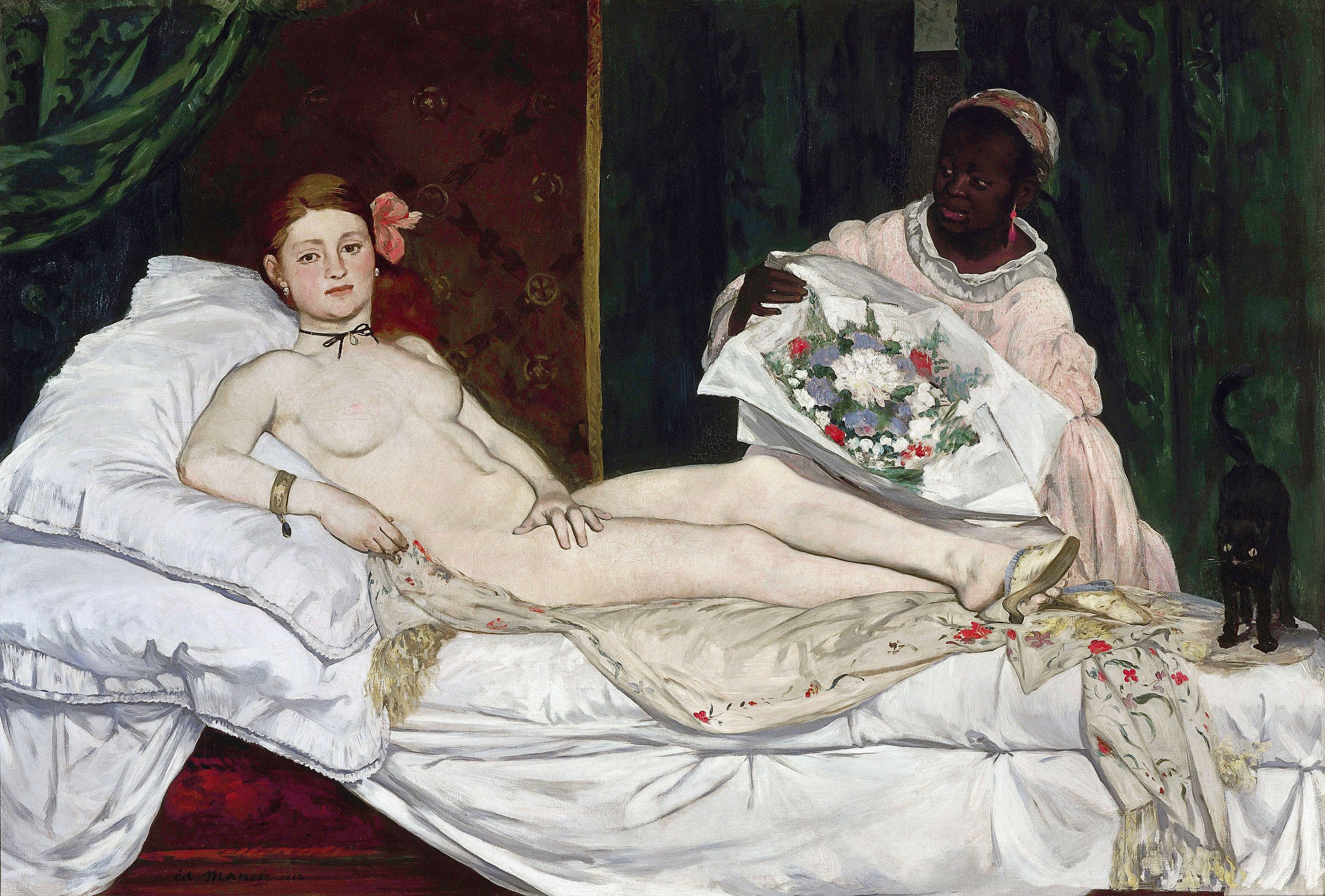

- Édouard Manet, Olympia (1863)
- Édouard Manet, Un bar aux Folies Bergère (1882)
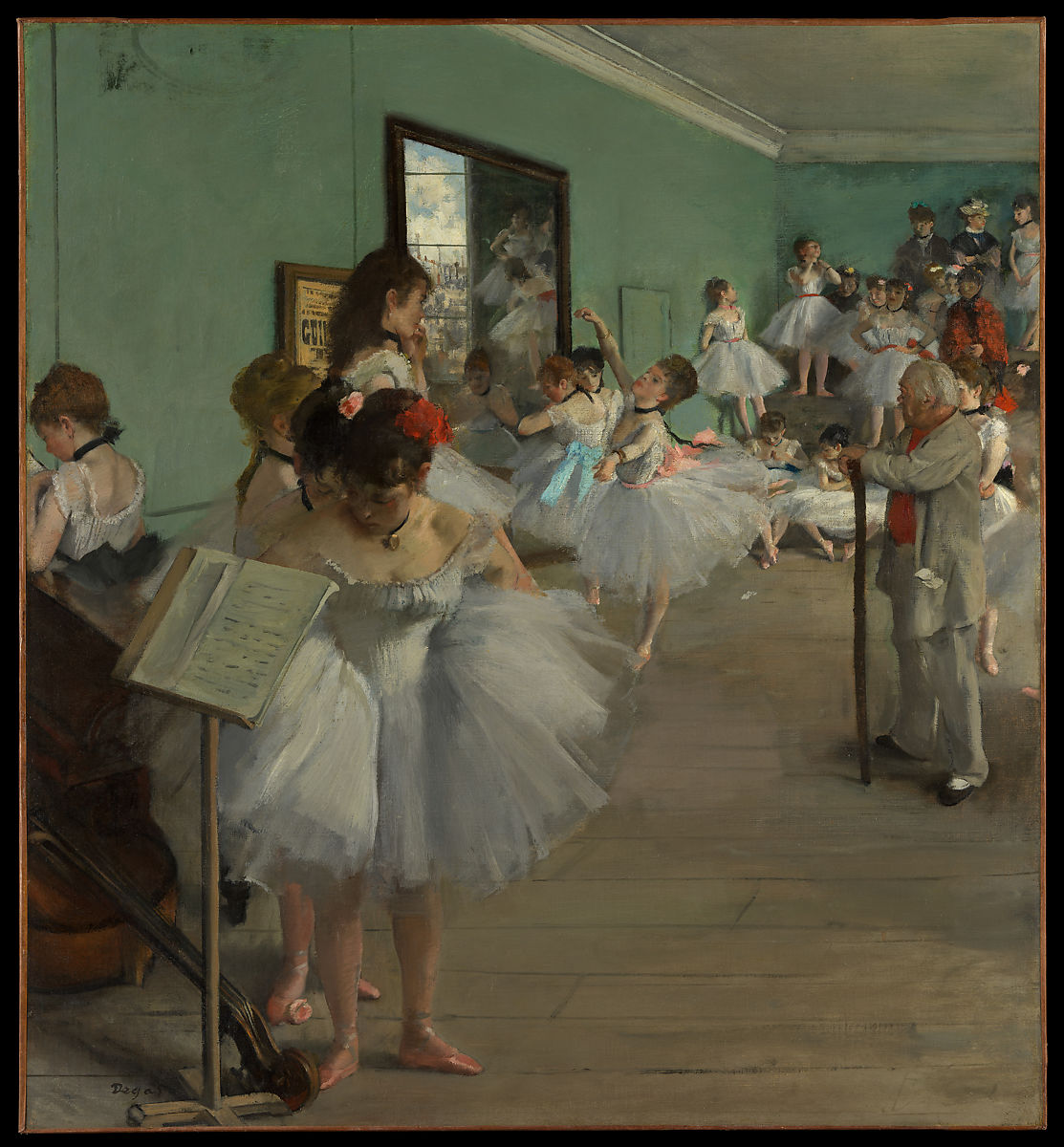
- Edgar Degas, The Dance Class (1874)
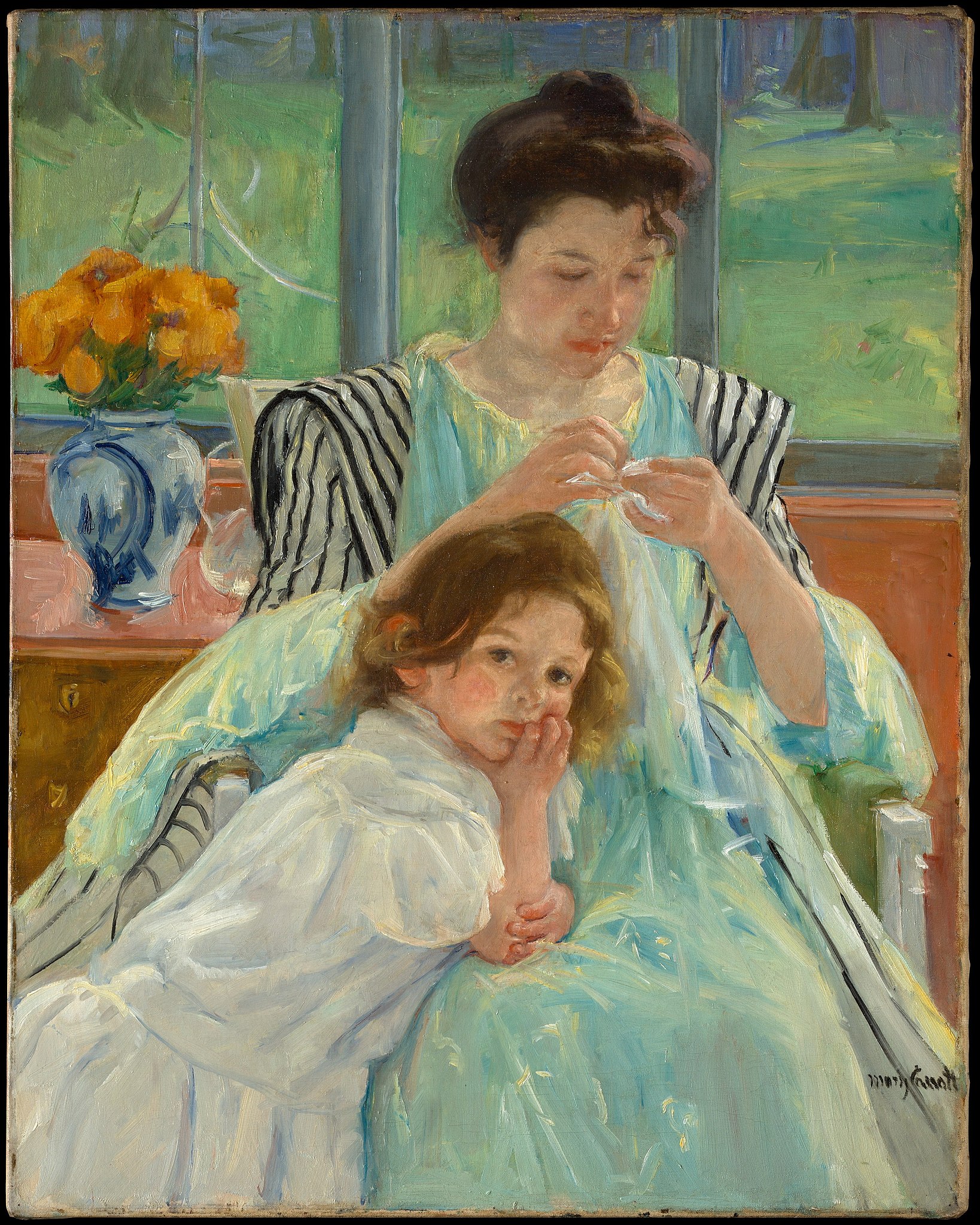
- Mary Cassatt, Young Mother Sewing (1893)
Viewing 2, a close study of Claude Monet’s Houses of Parliament (1899-1904):


Monet created this exquisite series during a series of visits to London. Fascinated with the city’s fog and other atmospherics, he positioned himself across the river, in front of St. Thomas’ Hospital. The paintings were begun on site, then completed at his home in Giverny with the aid of photographs. A 2006 study published in the Proceedings of the Royal Society showed that the paintings are sufficiently accurate as to provide a useful empirical record of London’s fogs—a phenomenon caused by urban pollution and consigned to history following the passage of environmental legislation in 1956 (source).
Writing: Respond to ONE of the following prompts. Keep your response short, posting as a reply under the appropriate heading in the comments section:
- Point to a stylistic or thematic pattern you see in some or all of these paintings.
- Point to a striking detail in one particular painting.
- Point to a painting that strikes you as betraying the influence of photography’s “way of seeing.”