
Loving the Machine
In the years leading up to World War I, a group of Italian artists came together under the banner of Futurism. Whereas Art Nouveau sought compromise with modernity, reshaping metal and glass in soft organic curves, the futurists welcomed the hard edges and high speeds of machinery.
 When conflict broke out in 1914, it was greeted with enthusiasm across Europe, but for most that excitement gave way to horror as reports filtered back from the front lines of the meat grinder of trench warfare. Paradoxically, the era’s powerful technologies—machine guns, artillery shells—produced stalemate rather than speedy victory. But while this experience left many determined to make the “Great War” the “War to End All Wars,” the Futurists remained enamored of both machinery and armed conflict, believing that violence could reenergize Italy. Unsurprisingly, in the years after the war’s end in 1918, they allied themselves with the National Fascist Party of Benito Mussolini.
Reading: “The Futurist Manifesto,” published in 1909 by Filippo Marinetti on the front page of the Parisian daily Le Figaro (Blackboard).
Viewing: examples of Futurist art:
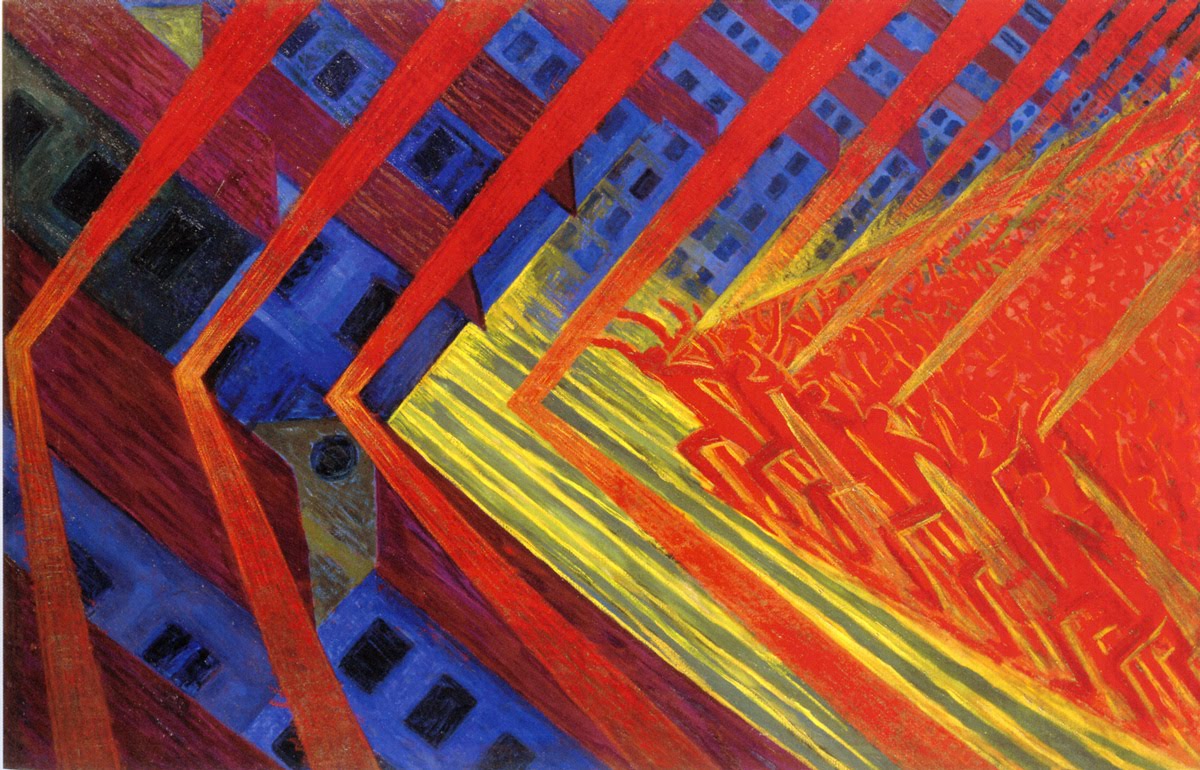


- Luigi Russolo, The Revolt (1911)
- Luigi Russolo, Dynamism of an Car (1913)
- Umberto Boccioni, Unique Forms of Continuity in Space (1913)
- Gino Severini, Memories of a Journey (1911)
- Gino Severini, Armored Train in Action (1915)
- Filippo Marinetti, In the Evening, Lying on Her Bed, She Reread the Letter from Her Artilleryman at the Front (1919)
Writing: Respond to ONE of the following prompts. Keep your response short, posting as a reply under the appropriate heading in the comments section:
- Point out a key contrast OR continuity in the Futurist art featured above.
- Point out a key contrast OR continuity between Marinetti’s 1909 manifesto and one of the Futurist artworks.