
Expressionism
Expressionism in art is often traced to the influence of Edvard Munch, whose Scream captures the artist’s tortured soul. In the years before the War, Expressionism spread from painting to poetry, drama and film and after the war it came to define the Avant-Garde in Weimar Germany.
Reading: Strickland, pp 123, 142-44.
Viewing: Expressionist art


- Edvard Munch, The Scream (earliest version 1893; this version 1910)
- Egon Schiele, Self-Portrait (1910)
- Otto Dix, Storm Troopers Advance under a Gas Attack (1924)
- Otto Dix, Portrait of the Journalist Sylvia von Harden (1926)
- Max Beckmann, Self-Portrait with Champagne Glass (1919)
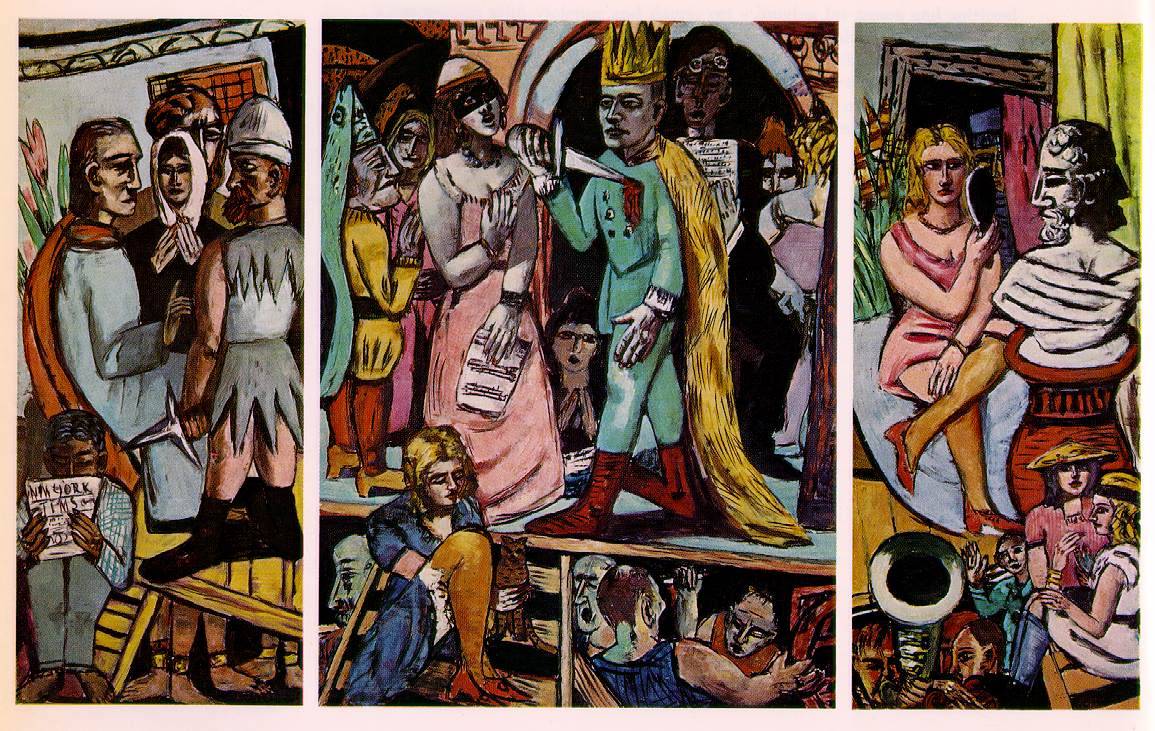
- Max Beckmann, The Actors (1942)
Writing: Respond to ONE of the following prompts. Keep your response short, posting as a reply under the appropriate heading in the comments section:
- Point to a stylistic or thematic pattern you see in some or all of these artworks.
- Point to a striking detail in one particular artwork.
- Given that “anomie” is defined as the loss of social norms, point to a particular artwork and explain how it challenges or violates the viewer’s normative expectations.